The promise of the bioeconomy is vast: renewable materials, carbon sequestration, and a shift away from fossil fuels. Yet, despite the buzz around hemp and industrial regeneration, we aren’t seeing the explosive growth predicted. Why?
The problem isn’t the crop. It’s the architecture of our industry.
The Synergistic Gap
We are currently operating in a „Synergistic Gap.” We have the theoretical organizational models (product-market synergy) and the raw biological potential (hemp), but we lack the physical infrastructure to connect them efficiently.
Our current industrial landscape is characterized by three critical failures:
1. Fragmented Processing
Today, a hemp stalk might travel hundreds of kilometers to a decortication plant for fiber, while the seeds are shipped elsewhere for oil pressing, and the „waste” biomass is left to rot or burned. This fragmentation destroys margins. Redundant overhead and transportation costs eat up the profit before the product even hits the shelf.
2. The Single-Stream Trap
Most facilities are designed for a single output—optimizing only for fiber or only for CBD. This approach systematically wastes up to 60% of the plant’s potential value. In a regenerative economy, „waste” is just a resource in the wrong place. By ignoring complementary biomass streams, we are leaving money—and carbon credits—on the table.
3. Knowledge Silos
Research institutions, farmers, and manufacturers often operate in isolation. This prevents the rapid feedback loops necessary for innovation. A farmer might grow a cultivar that processes poorly, but without direct feedback from the factory, they’ll plant it again next year.
The Solution: Enter the Hemphub
To bridge this gap, we need more than just factories; we need Hemphubs.
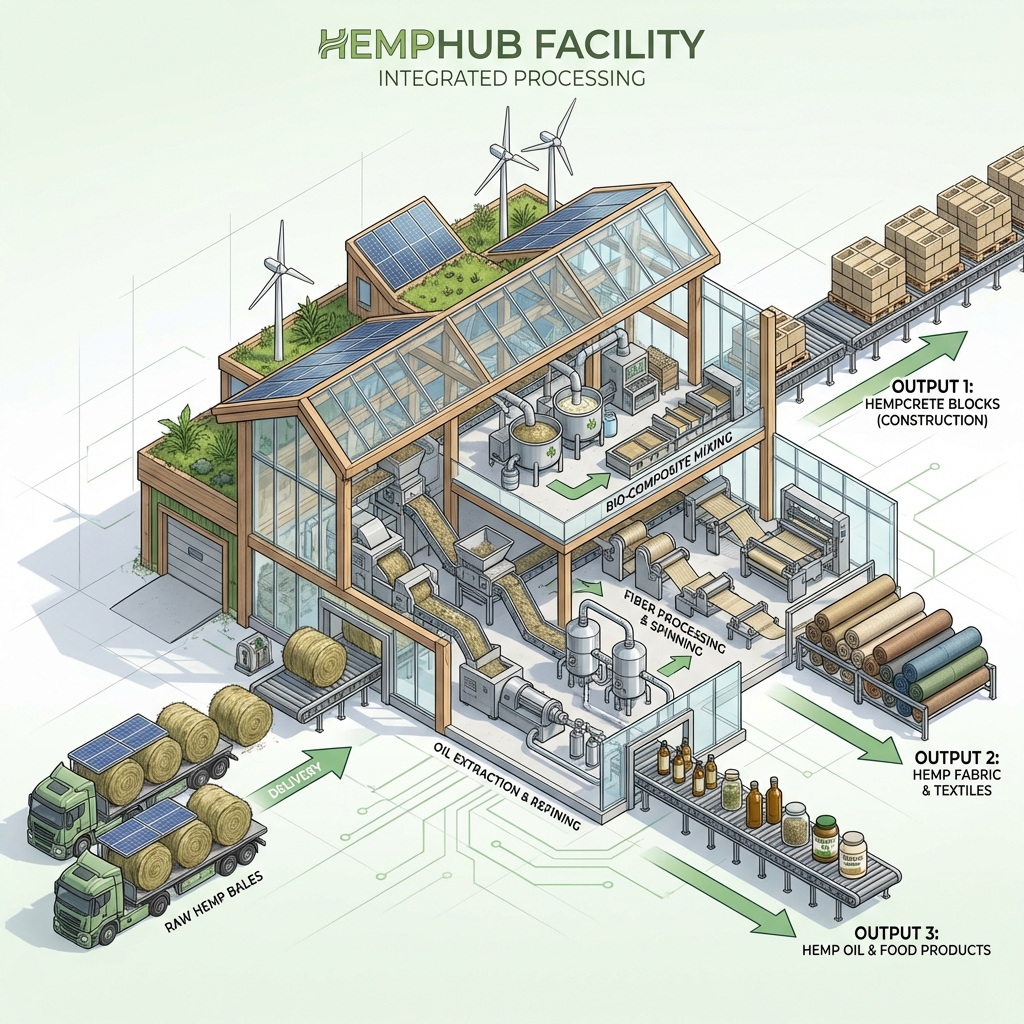
A Hemphub is defined as a Regenerative Industrial Node: a geographically distributed, vertically integrated facility that co-locates cultivation, multi-stream processing, research, and market access.
By consolidating these functions into a single node, we move from a linear, extractive model to a circular, regenerative one. This isn’t just about efficiency; it’s about unlocking the 2+2=5 effect—where the integrated whole produces exponentially more value than the sum of its isolated parts.
Tomorrow: We will peel back the roof and look inside. Join us as we explore the Anatomy of a Hemphub and the specialized zones that make this machine run.
Source: This strategic framework derives from the Hemphub Infrastructure Strategy.




Parašykite komentarą