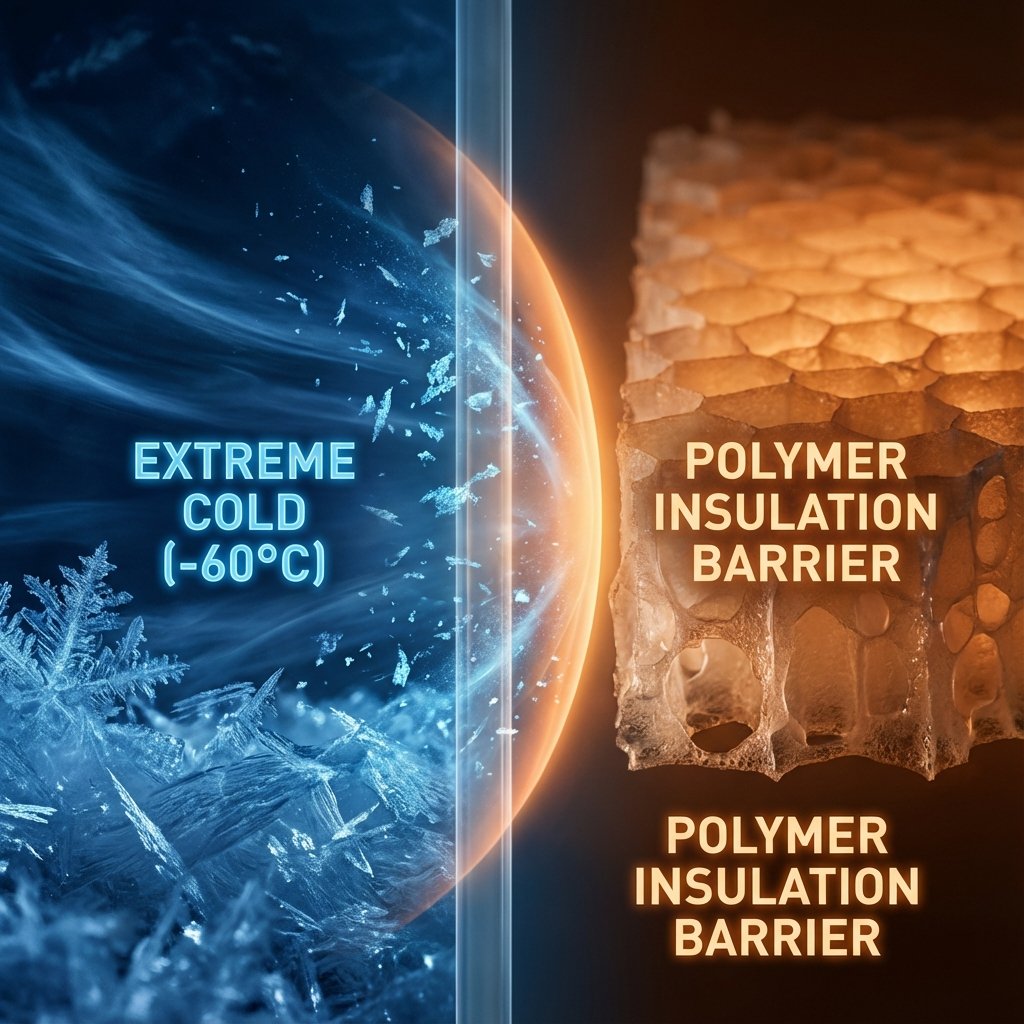
It’s really cold outside. As temperatures drop and winter tightens its grip, we often retreat indoors or bundle up in layers. But have you ever stopped to consider what actually keeps you warm? More often than not, it’s a polymer.
From the insulation in your walls to the fleece jacket on your back, plastics play a critical role in our ability to survive and thrive in freezing conditions.

The Science of Cold: Glass Transition
Not all plastics like the cold. If you’ve ever left a cheap plastic garden chair out in freezing weather and seen it crack, you’ve witnessed the Glass Transition Temperature (Tg).
Above its Tg, a polymer is flexible and rubbery. Below it, the molecular chains lose their ability to move freely, and the material becomes hard, glassy, and brittle. Designing polymers for cold environments—whether it’s for a ski boot or a pipeline in Alaska—requires carefully engineering the material to ensure its Tg is well below the operating temperature.
Beating the Chill: Insulation
The most effective way to combat cold is to trap heat. Polymers are the champions of thermal insulation.
- Expanded Polystyrene (EPS): Commonly known as Styrofoam, this rigid foam is 98% air trapped within a polymer matrix. Since air is a poor conductor of heat, EPS is an excellent insulator used in building construction to keep homes warm and energy bills low.
- Polyurethane (PU) Foam: This versatile foam expands to fill gaps and cracks, creating an airtight seal that prevents cold drafts from entering our living spaces.
High-Tech Winter Wear
Natural fibers like wool are great, but synthetic polymers have revolutionized winter clothing.
- Polyester Fleece: Engineered to mimic the insulating properties of wool but at a fraction of the weight. The structure of the fibers traps pockets of warm air close to the body.
- Waterproof Shells: Fabrics like Gore-Tex use a microporous membrane of PTFE (Polytetrafluoroethylene). The pores are small enough to stop liquid water (rain and snow) from getting in, but large enough to let water vapor (sweat) escape, keeping you dry and warm.
Extreme Frontiers
In the most unforgiving environments on Earth (and beyond), polymers are essential. Researchers are developing new „smart” polymers that can change their thermal properties on demand, or self-healing materials that recover from cold-induced cracking.
So, as the temperature plunges this week, remember: that layer of warmth protecting you is likely a marvel of polymer science.




Parašykite komentarą