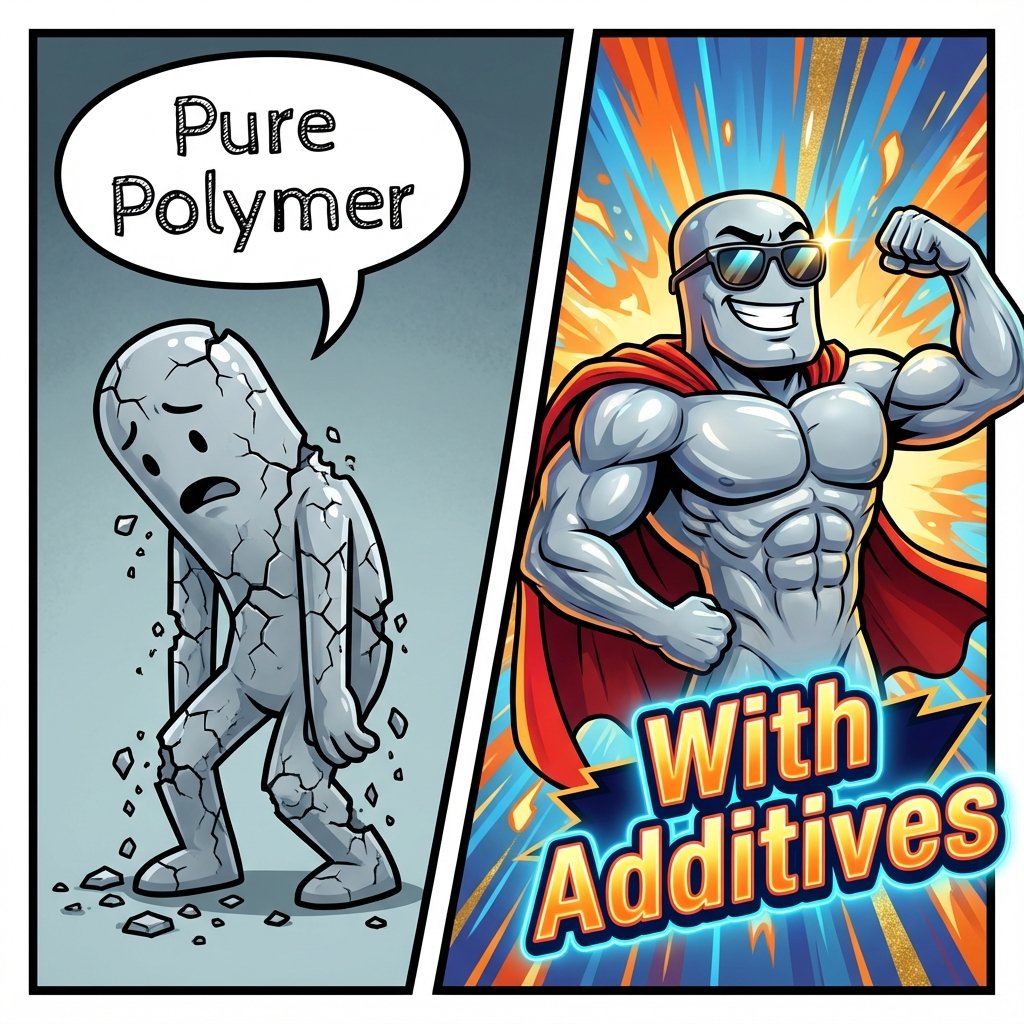
If polymers were superheroes, additives would be their superpowers. While we often talk about „plastic” as a single material, the reality is that pure, raw polymers are often brittle, hard to process, or prone to degrading in sunlight. It is the additives—the chemical „spices” mixed into the recipe—that turn a basic resin into the durable, flexible, or heat-resistant material we use every day.
In this guide, we dive into what these additives are, why they matter, and the exciting innovations shaping the market in 2025.
What Are Polymer Additives?
Polymer additives are substances added to the polymer matrix to improve its processing, prolong its life, or achieve specific physical or chemical properties. Without them, PVC piping would crack in the winter, car dashboards would crumble in the sun, and electric cables would be stiff and dangerous.
Common Types and Their Functions
The world of additives is vast, but here are the heavy lifters:
- Plasticizers: These make rigid plastics flexible. They are the reason your garden hose doesn’t snap when you coil it.
- Stabilizers (UV & Heat): Think of these as „sunscreen” for plastic. They prevent the material from breaking down under UV rays or high processing temperatures.
- Flame Retardants: Critical for safety, these inhibit or delay the spread of fire in electronics and construction materials.
- Impact Modifiers: These absorb shock, making materials tough enough for car bumpers and safety helmets.
- Nucleating Agents: These speed up crystallization, allowing manufacturers to produce parts faster and with better mechanical properties.
2025 Trends: The Shift to Sustainability
The „old school” of additives relied heavily on fossil-fuel-derived chemicals. However, recent market analysis from BCC Research projects the global plastics additives market to reach $80.7 billion by 2029, driven largely by a shift toward sustainable solutions.
1. Bio-based Additives
Innovators are now deriving additives from renewable sources like plant oils and nut shells. For instance, recent research highlighted by StartUs Insights points to the use of pecan nutshell extracts as effective antioxidants and UV stabilizers. These bio-based alternatives reduce the carbon footprint of the final product without sacrificing performance.
2. „Smart” Additives
We are entering the era of functional materials. Self-healing additives are being developed that can repair micro-cracks in the material automatically, extending the lifespan of products and reducing waste. Antimicrobial additives are also seeing a surge, particularly in healthcare and food packaging.
3. Additives for Recycling (Circular Economy)
One of the biggest challenges in recycling is that plastics degrade each time they are melted down. New „repair” additives (like chain extenders) are being designed to restore the molecular weight of recycled polymers, making recycled plastic almost as good as new. Reports from Precedence Research indicate this sector is one of the fastest-growing as the EU pushes for higher recycled content mandates.
Conclusion
Additives are the unsung heroes of the polymer industry. They allow us to do more with less material and are now pivoting to help solve the very environmental problems plastics have helped create. As we move through 2025, expect to see „smart” and „bio-based” become the new standard on spec sheets everywhere.
Sources: BCC Research, Precedence Research, StartUs Insights, ScienceDaily.




Parašykite komentarą