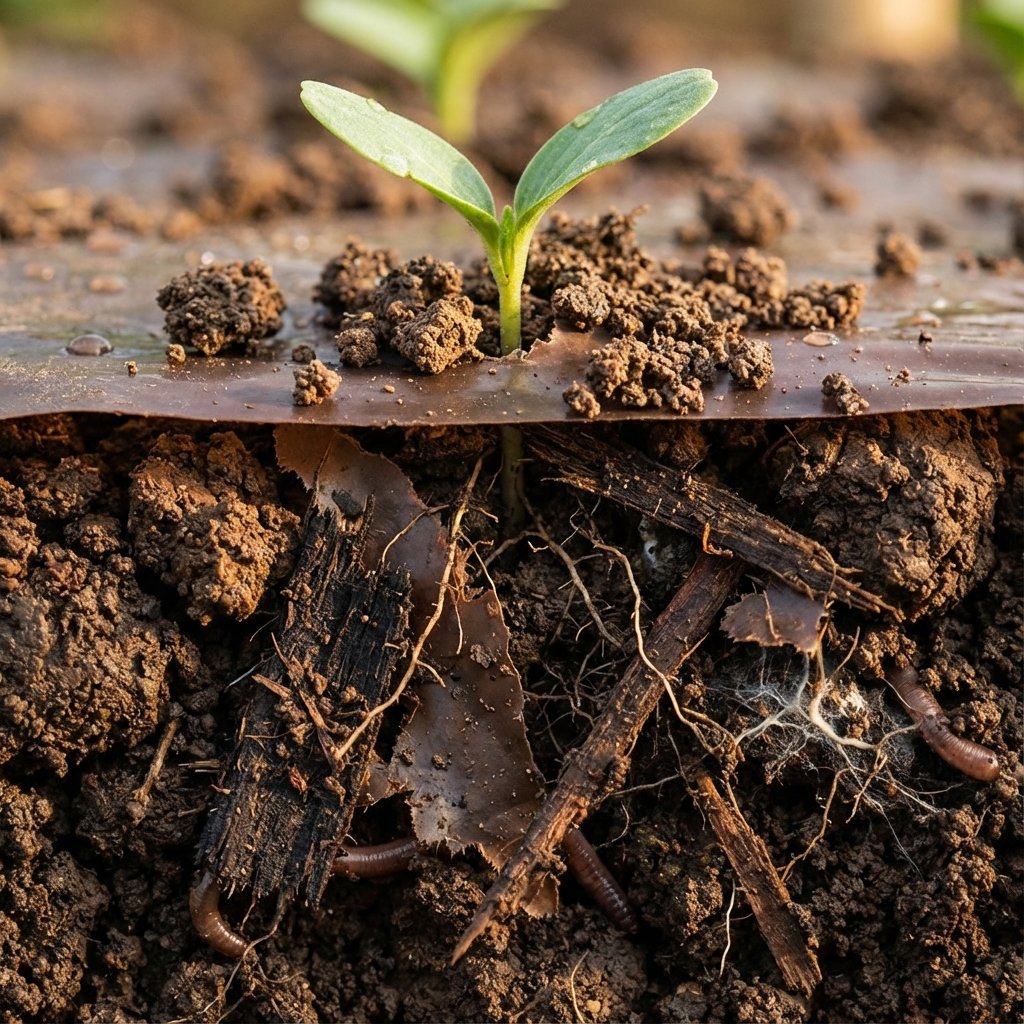
Modern agriculture adheres to a difficult contract: we need to produce more food for a growing population, but the very methods we use to boost yields are slowly destroying the foundation of farming—the soil itself.
Nowhere is this paradox more evident than in „plasticulture.” The use of polyethylene (PE) mulch films has revolutionized farming by suppressing weeds, conserving water, and increasing yields. But it has come at a terrible cost. We are coating our arable land in a layer of plastic that never truly leaves.
For Day 30, we are stepping away from abstract innovation to dig into a literal „close-to-earth” problem: The accumulation of microplastics in agricultural soil and the scientific imperative for certified soil-biodegradable alternatives.
The „White Pollution” Crisis
Walk through an intensively farmed field after harvest, and you will likely see tattered fragments of plastic film partially buried in the dirt. This is often referred to as „White Pollution.”
Conventional PE mulch films are thin (often 10–25 microns). When removed after a growing season, they tear easily. It is estimated that 10-20% of the film remains in the field even after retrieval efforts. Over decades, this accumulation reaches a tipping point.
The Real-World Impact on Soil Physics
Plastic residues are not inert bystanders. They actively degrade the physical properties of the soil:
1. Water Transport Blockage: Plastic fragments create impermeable barriers within the soil profile, disrupting the capillary movement of water and nutrients to plant roots.
2. Reduced Bulk Density: High levels of microplastics alter the soil structure, making it looser but less able to anchor roots effectively.
3. Yield Drag: Research has shown that residual plastic pollution can reduce crop yields by 10% to 25% in severely contaminated fields, negating the very benefits the plastic provided in the first place.
The Solution: Soil-Biodegradable Mulch Films (BDM)
The industry’s answer to this crisis is Soil-Biodegradable Mulch (BDM). However, this sector is rife with greenwashing and confusion. To understand the substance of this solution, we must look at the chemistry and the standards.
How It Works: Mineralization vs. Fragmentation
The most critical distinction for any buyer or policymaker is the difference between biodegradable and oxo-degradable.
- Oxo-degradable (The False Solution): These are conventional plastics with additives that cause the plastic to brittle and shatter into invisible microplastics when exposed to UV light. They do not biodegrade. They simply become impossible to see and impossible to clean up.
- True Biodegradable (The Science): True BDMs (made from polymers like PBAT, PLA, or PHA blends) are designed to be food for soil microbes. Bacteria and fungi in the soil release enzymes that depolymerize the film’s long molecular chains into smaller monomers. These monomers are then consumed by the microbes, resulting in Mineralization.
The equation for true biodegradation is:
$$ Polymer + O_2 + Microbes \rightarrow CO_2 + H_2O + Biomass $$
There is no microplastic residue left behind—only basic elements and organic matter that enriches the soil.
The Gold Standard: EN 17033
For years, the market lacked clear rules. „Biodegradable” was a marketing term without technical backing. That changed with the introduction of EN 17033, the first European standard specifically for biodegradable mulch films.
If a product claims to be soil-biodegradable but does not cite EN 17033, it should be viewed with skepticism. This standard requires:
1. 90% Biodegradation within 24 months in absolute soil conditions (not industrial composters).
2. Ecotoxicity Testing: Proving that the breakdown residues have zero negative effect on earthworms, plants, or soil microorganisms.
3. Heavy Metal Limits: Strict caps on the chemical composition of the film.
The Economic Reality
Farmers operate on thin margins, and BDM films are currently 2-3 times more expensive than conventional PE mulch. Why would a farmer switch?
The „sticker price” is deceptive because it ignores the labor and disposal costs.
| Cost Factor | Conventional PE Film | Biodegradable (BDM) Film |
|---|---|---|
| Material Cost | Low | High |
| Installation | Same | Same |
| Removal Labor | High (Labor intensive to pull up) | Zero (Tilled into soil) |
| Disposal Fees | High (Landfill or washing lines) | Zero |
| Soil Health Cost | Cumulative degradation | Regeneration |
When the elimination of retrieval labor and disposal fees is factored in, the total cost of system (TCS) for biodegradable films is becoming competitive, especially for crops like tomatoes, peppers, and melons where retrieval is difficult.
Conclusion
The problem of agricultural plastic is a ticking time bomb directly beneath our food systems. We cannot simply continue to mix conventional plastic into the earth and expect our soil to remain fertile.
Switching to certified soil-biodegradable polymers is not just a „nice-to-have” eco-trend; it is a technical necessity for preserving the arable land we rely on. For producers, the future lies in polymers that know when their job is done—materials that return to the earth as gracefully as the plants they protected.




Parašykite komentarą