[Error Content Generation]: 404 models/gemini-2.0-flash-exp is not found for API version v1beta, or is not supported for generateContent. Call ListModels to see the list of available models and their supported methods.
Autorius: antanasvalciukas@gmail.com
-
The Call to Action – Your Role in the Hemphub Revolution
Executive Summary:
Technology alone cannot build a regenerative economy; it requires human collaboration. In this concluding article of our Hemphub series, we translate the Hemphub Infrastructure Strategy into concrete action items for key stakeholders. We call on Policymakers to create special development zones, Investors to deploy patient capital, Farmers to integrate vertically, and Communities to embrace the „Green Industrial Node” model. This is the roadmap from blueprint to reality.
For the last week, we have explored the Hemphub—a revolutionary infrastructure model designed to solve the fragmentation of the hemp industry. We’ve seen the Blueprints, walked through the Archetypes, and examined the Rollout Strategy.
But a blueprint is just paper until people pick up tools. The Hemphub is not a product you buy; it is a system you build. And it requires a coalition to build it.
Drawing from the final sections of the Hemphub Infrastructure Strategy, we conclude this series with a direct call to action. Whether you are a politician, a banker, a farmer, or a neighbor, you have a role to play in this regenerative revolution.
1. For Policymakers: Create the Zone
The biggest hurdle isn’t technology (or even the Challenges we discussed previously); it’s red tape.
* The Action: Establish „Hemphub Development Zones” in rural areas. Treat these facilities like public utilities—essential infrastructure that deserves fast-tracked permitting and tax incentives.
* The Goal: Stop regulating hemp like a drug and start regulating it like the strategic bio-resource it is.2. For Investors: Build the Missing Middle
The venture capital „unicorn” model doesn’t work for infrastructure. We need Patient Capital.
* The Action: Structure 7-10 year investment vehicles that understand the biological timeline of soil regeneration. Move away from „blitzscaling” software brands and put capital into hard assets—steel, concrete, and decorticators.
* The Goal: Capture long-term, stable cash flows (like a toll road) rather than chasing a quick exit.3. For Farmers: Own the Pipe
Don’t just be a supplier of raw materials.
* The Action: Form regional cooperatives to negotiate collectively. Better yet, invest in the Hemphub itself.
* The Goal: Vertical Integration. If you own a stake in the processing plant, you don’t just get paid for the stalk; you get a dividend from the shirt and the insulation block sold at the end of the line.4. For Communities: Welcome the Future
NIMBYism („Not In My Backyard”) is the enemy of progress.
* The Action: When a Hemphub is proposed in your region, engage with it. Demands transparency, yes, but recognize the opportunity.
* The Goal: A Hemphub brings high-quality technical jobs and restores local soil. It turns a „dying rural town” into a „Green Industrial Node.”
Conclusion: The Structural Necessity
The Hemphub is not just a nice idea. It is a structural necessity.
Without it, hemp will remain a niche boutique industry, forever trapping farmers in low-margin commodity cycles. With it, we unlock the 2+2=5 Synergy. We eliminate waste, we regenerate the land, and we create a distributed industrial network that is resilient to the shocks of the future.
The climatic and economic clocks are ticking. The blueprint is ready. The question is no longer if we should build them, but who will be the first to break ground.
Will it be you?
Frequently Asked Questions (FAQ)
Q: Where can I find the full business plan for a Hemphub?
A: The concepts discussed here are derived from the Hemphub Infrastructure Strategy. While this outlines the strategic framework, specific business plans depend on local feasibility studies.Q: Is „Patient Capital” just a euphemism for „low returns”?
A: No. It refers to the timeline, not the magnitude. Infrastructure investments often yield robust returns (15-25% IRR) but they require time to stabilize (3-5 years) compared to the rapid flip cycles of tech VC.Q: How can a small farmer participate if they don’t have capital to invest?
A: Through cooperatives. By pooling resources with 50-100 other local growers, small farmers can collectively buy equity in the facility, gaining a seat at the table without needing millions individually.
Topical Authority Note:
This content is based on Section X and the Conclusion of the Hemphub Infrastructure Strategy. Analysis performed by [Antigravity Agent] verified against the primary thesis document.
Source: The Synergistic Imperative And The Hemphub Infrastructure
Image Generation Prompt:
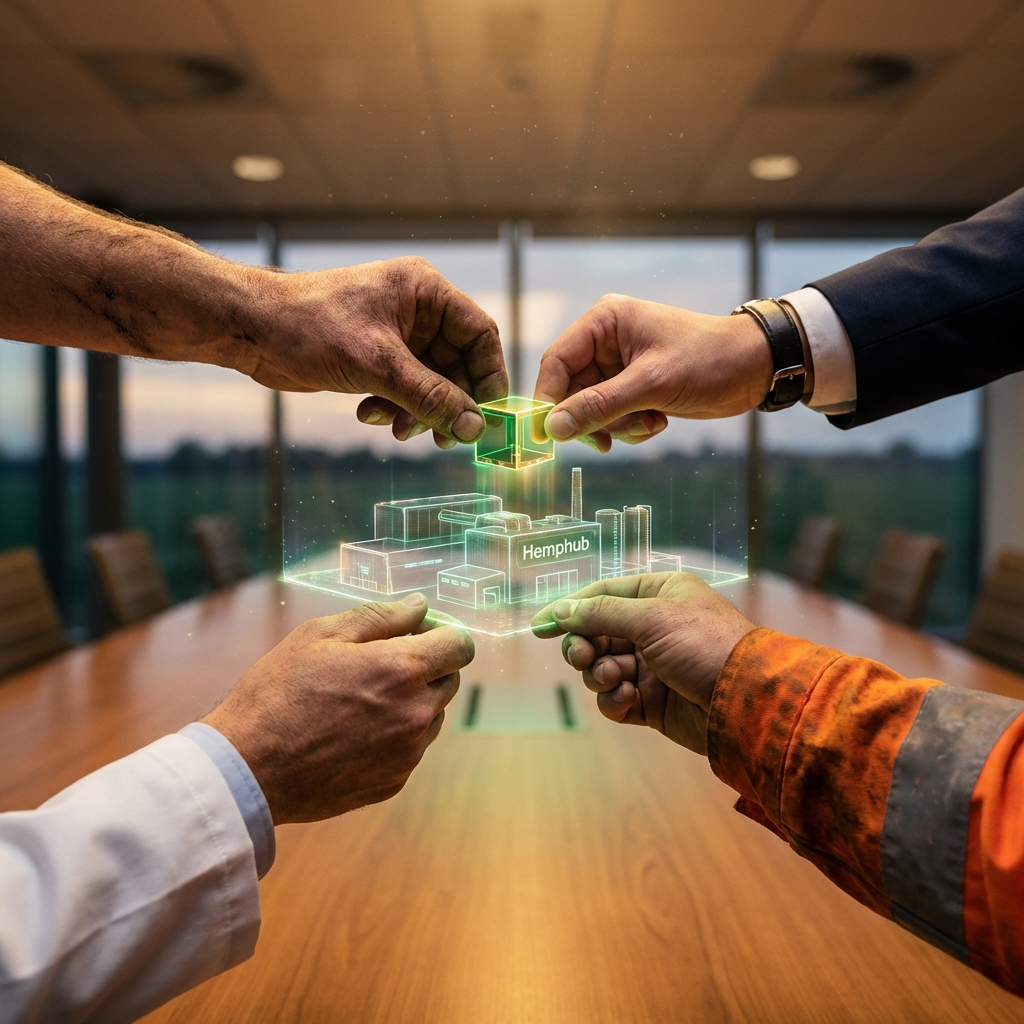
Prompt: A cinematic close-up shot of four diverse hands coming together to place the final piece of a glowing, holographic 3D model of a „Hemphub” facility. The hands belong to: a farmer (weathered, soil-stained), a scientist (lab coat cuff), an investor (business suit), and a construction worker (high-vis sleeve). The background is a blurred, warm-lit meeting room looking out over a green field. The hologram glows with golden and green data streams. Symbolizes collaboration, completion, and the human element of infrastructure. High detail, 8k.
-
One Size Does Not Fit All – Three Hemphub Archetypes
Executive Summary:
A Hemphub is not a rigid franchise; it is an adaptable industrial node. While the core principle of synergistic processing remains constant, the physical implementation shifts based on geography. In this article, we analyze three distinct archetypes defined in the Hemphub Infrastructure Strategy: the high-volume Fiber Model (Northern Europe), the high-margin Cannabinoid Model (North America), and the nutritional Food Model (Asia-Pacific). Understanding these variations is critical for investors and developers to match infrastructure with local agronomic reality.
Over the last few days, we’ve defined the Hemphub as a universal concept: a regenerative combined-cycle node. However, the application of this concept is not rigid. A Hemphub in the snowy plains of Northern Europe looks very different from one in the sun-drenched valleys of Colorado or the agricultural terraces of Asia.
Drawing from Section VI of the Hemphub Infrastructure Strategy, today we explore the three distinct „Archetypes” of the Hemphub. These models demonstrate how the infrastructure adapts to local geography, market demands, and agronomic conditions while maintaining the core principle of synergistic processing.
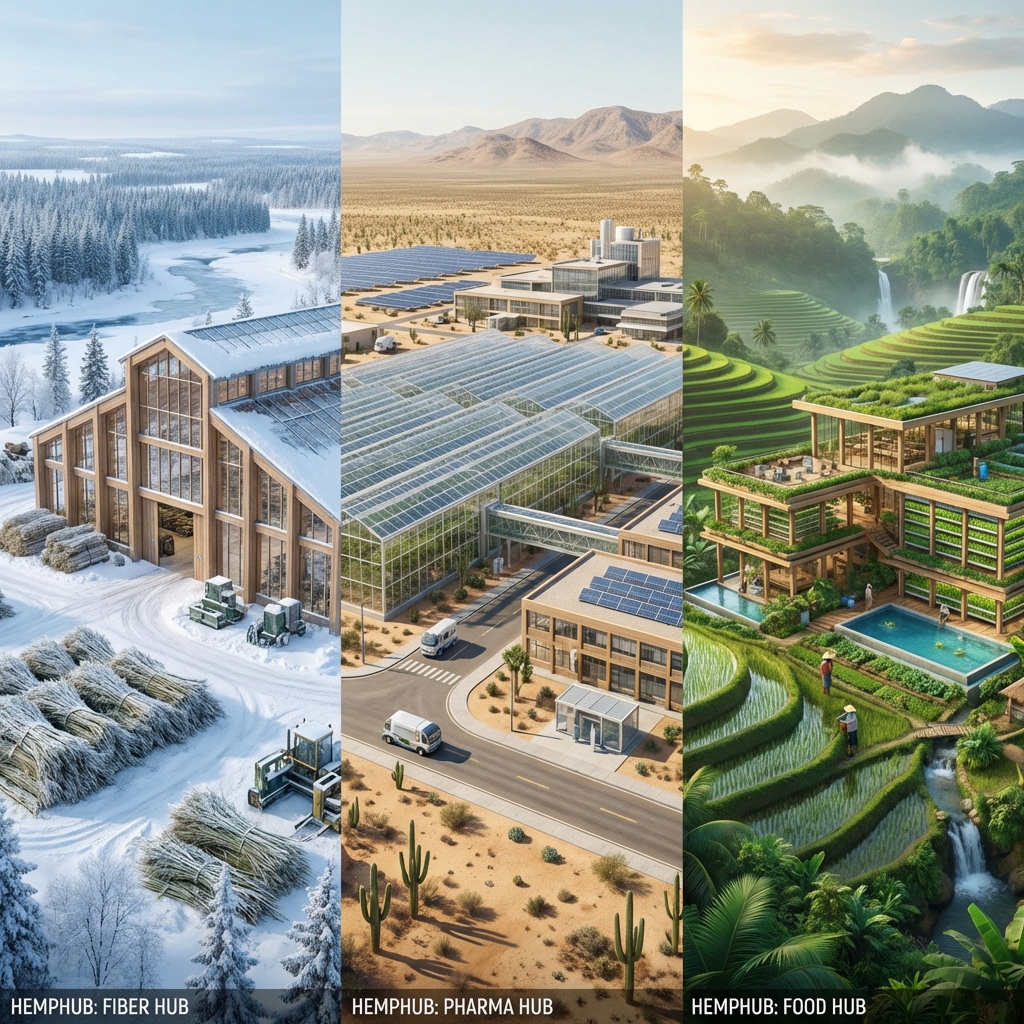
1. The Fiber-Focused Hemphub (Northern European Model)
Ideal Location: Rural France, Netherlands, or Baltics.
Primary Zone: 2,000 hectares cultivation radius.This archetype is the heavy lifter of the bioeconomy. Built in regions with strong industrial traditions and construction demands, its „North Star” is biomass volume.
- The Engine: Large-scale decortication lines capable of processing massive tonnage of stalks.
- The Output: High-performance technical textiles for the automotive industry and hempcrete binders for green building.
- The Synergy: While fiber is the main driver, the „dust” and shives are not wasted—they power the facility’s own heating systems or are pelletized for local energy, ensuring a closed-loop energy cycle.
- Economic Profile: High volume, stable margins. Revenue projected at €12-18M annually.
2. The Cannabinoid-Focused Hemphub (North American Model)
Ideal Location: Oregon, Colorado, or Southern Europe.
Primary Zone: 500 hectares cultivation radius.In regions where legislation permits and wellness markets are mature, this model pursues high-value extraction. It is smaller in land area but more capital-intensive in technology.
- The Engine: cGMP-compliant supercritical $CO_2$ or ethanol extraction laboratories.
- The Output: Pharmaceutical-grade CBD, CBG, and minor cannabinoids for wellness and medical applications.
- The Synergy: Unlike the „boutique” growers of the past who threw away the stalk, this Hemphub captures the fiber and hurd as valuable co-products, selling them to nearby construction or textile hubs. It turns a „waste disposal cost” into a secondary revenue stream.
- Economic Profile: Lower volume, high margin. Revenue projected at $15-25M annually.
3. The Food & Wellness Hemphub (Asia-Pacific Model)
Ideal Location: Australia, New Zealand, or China.
Primary Zone: 1,500 hectares cultivation radius.Focusing on the „Superfood” revolution, this archetype prioritizes the seed.
- The Engine: Cold-pressing facilities for oil and dehulling lines for hearts.
- The Output: Omega-rich hemp seed oil, protein powders, hemp milk, and cosmetic bases for export.
- The Synergy: The residual seed cake (after pressing) is not discarded but upcycled into animal feed or high-protein flour. The stalks are baled and sent to regional biocomposite manufacturers, ensuring that the „food crop” still supports the „industrial crop” ecosystem.
- Economic Profile: Balanced volume and margin. Revenue projected at AUD $10-16M annually.
The Chameleon Infrastructure
What makes the Hemphub strategy powerful is this adaptability. It is not a rigid franchise model but a modular framework. A region can start as a Fiber Hub and, as legislation changes, add a Cannabinoid extraction module (as detailed in our Rollout Strategy).
The Hemphub is a chameleon—it takes on the color of its local economy while growing the same green future.
Frequently Asked Questions (FAQ)
Q: Can a single Hemphub be all three types at once?
A: Eventually, yes. However, specialized starts are recommended to manage initial CapEx ($5-20M). Most hubs begin with one primary focus (Fiber, Food, or Flower) and add modules in Years 3-5.Q: Why does the Fiber model require so much more land (2,000 ha)?
A: Fiber is a high-volume, lower-margin commodity compared to CBD. To achieve the 24/7 distinct throughput required for profitability, a fiber decortication plant needs distinct tonnage that only a larger acreage can provide.Q: Are these revenue projects guaranteed?
A: No. These are estimated modeled ranges based on current market prices for varied outputs. Actual performance depends on crop yield, operational efficiency, and local market uptake.
Topical Authority Note:
This content is based on Section VI of the Hemphub Infrastructure Strategy. Analysis performed by [Antigravity Agent] verified against the primary thesis document.Tomorrow: We conclude our series on the Hemphub Infrastructure. We will layout the Stakeholder Call to Action—what you (investors, policymakers, farmers, and citizens) can do to bring this vision to life. Join us for Day 52: The Call to Action.
Source: The Synergistic Imperative And The Hemphub Infrastructure
Image Generation Prompt:
Prompt: A split-screen triptych architectural visualization showing three distinct variations of the „Hemphub” industrial facility adapted to different environments. Left panel: „Fiber Hub” in a snowy, flat Northern European landscape with piles of raw stalks. Center panel: „Pharma Hub” in a sunny, arid North American region with high-tech glass greenhouses. Right panel: „Food Hub” in a lush, green Asia-Pacific terrace setting. All three share a common futuristic, sustainable design language (wood, glass, greenery) but differ in scale and surrounding biome. High detail, photorealistic, 8k.
-
Navigating the Obstacles – Critical Success Factors for the Hemphub Revolution
Yesterday, we explored the immense potential of the Federated Hemphub Network, envisioning a globally connected ecosystem of regenerative industrial nodes. But vision without execution is hallucination. The path from „blueprint to network” is not a straight line; it is an obstacle course filled with economic, regulatory, and technical hurdles.
Today, we confront the hard reality of building this infrastructure. Drawing from Section VIII of the Hemphub Infrastructure Strategy, we identify the five critical challenges facing this revolution and, more importantly, the strategic levers we must pull to overcome them.
1. The Capital Barrier: Breaking the $5-20M Wall
Challenge: Capital Intensity
A fully operational Hemphub is not a cheap endeavor. With initial capital requirements ranging from $5 million to $20 million, financing is the single largest barrier to entry for local communities and independent entrepreneurs. Traditional lenders often view bio-industrial infrastructure as „high risk,” stifling projects before they break ground.
Critical Success Factor: Innovative Financing Models
To bridge this gap, we must move beyond simple bank loans.
* Pilot Projects: Demonstrate viable unit economics on a smaller scale to de-risk larger investments.
* Public-Private Partnerships: Leverage government grants for green infrastructure to cover non-recoverable initial costs.
* Turnkey Franchise Models: Standardized designs reduce development costs and provide investors with a proven „business-in-a-box” model.
* Bioeconomy Investment Vehicles: Creating specialized funds that understand the longer time horizons and massive potential returns of regenerative infrastructure.2. The Regulatory Maze: Harmonizing the Rules
Challenge: Regulatory Uncertainty
Hemp is global, but regulations are intensely local. From varying THC limits to zoning restrictions for processing facilities, the regulatory landscape is a patchwork quilt that shifts unpredictably. This creates a climate of uncertainty that freezes investment.
Critical Success Factor: Adaptive Compliance & Advocacy
Success requires a facility that can bend without breaking.
* Flexible Design: Engineering facilities that can easily pivot production lines (e.g., from CBD to fiber) if regulations change.
* Proactive Engagement: We don’t just follow rules; we help write them. Hemphubs must serve as demonstration sites for regulators, showing them what safe, standardized compliance looks like.
* Geographic Diversification: Spreading operations across multiple jurisdictions creates a natural hedge against localized policy shifts.3. The Technical Climb: Mastering Complexity
Challenge: Technical Complexity
A Hemphub is not just a barn; it is a sophisticated biorefinery. Integrating decortication, extraction, thermal conversion, and manufacturing under one roof requires mastering multiple distinct technical domains. The risk of operational failure is high without specialized expertise.
Critical Success Factor: The Knowledge Commons
We solve complexity with education and collaboration.
* Workforce Training: Investing heavily in specialized curriculums (like the one outlined in Appendix G) to build a skilled local workforce.
* Equipment Partnerships: Manufacturers shouldn’t just sell machines; they must be long-term technical partners.
* Networked R&D: When one Hemphub solves a technical glitch, the solution is shared instantly across the Federated Network, preventing others from repeating the same mistake.4. The Market Gap: Bridging Supply and Demand
Challenge: Market Development
We can build the factories, but who buys the products? Many hemp applications (like hempcrete or bioplastics) are in nascent markets. Consumer awareness is growing, but widespread adoption is not guaranteed.
Critical Success Factor: Lighthouse Customers
We need to manufacture demand as much as we manufacture products.
* Lighthouse Customers: Securing off-take agreements with major corporate partners who want to decarbonize their supply chains early.
* Sustainability Certification: Using the Global Hemp Ledger to prove the carbon-negative status of our products, giving them a premium differentiator in the marketplace.5. The Cultural Shift: Winning Hearts and Minds
Challenge: Cultural Resistance
Historical stigma associated with cannabis still lingers. Furthermore, industrial change often brings local resistance. Communities may fear noise, smell, or the unknown nature of „hemp” processing.
Critical Success Factor: Radical Transparency
A Hemphub must be a good neighbor.
* Community Engagement: Open days, educational tours, and transparent communication are non-negotiable.
* Shared Value: When the local community sees the jobs created and the environmental health restored, resistance turns into championship.
The challenges are significant, but they are surmountable. By anticipating these hurdles and embedding the solutions into the very design of the Hemphub infrastructure, we transform risk into resilience.
Tomorrow, we will look at the concrete steps to make this happen, detailing the Implementation Framework and the phases of development.
Source: The Synergistic Imperative And The Hemphub Infrastructure
Image Generation Prompt:
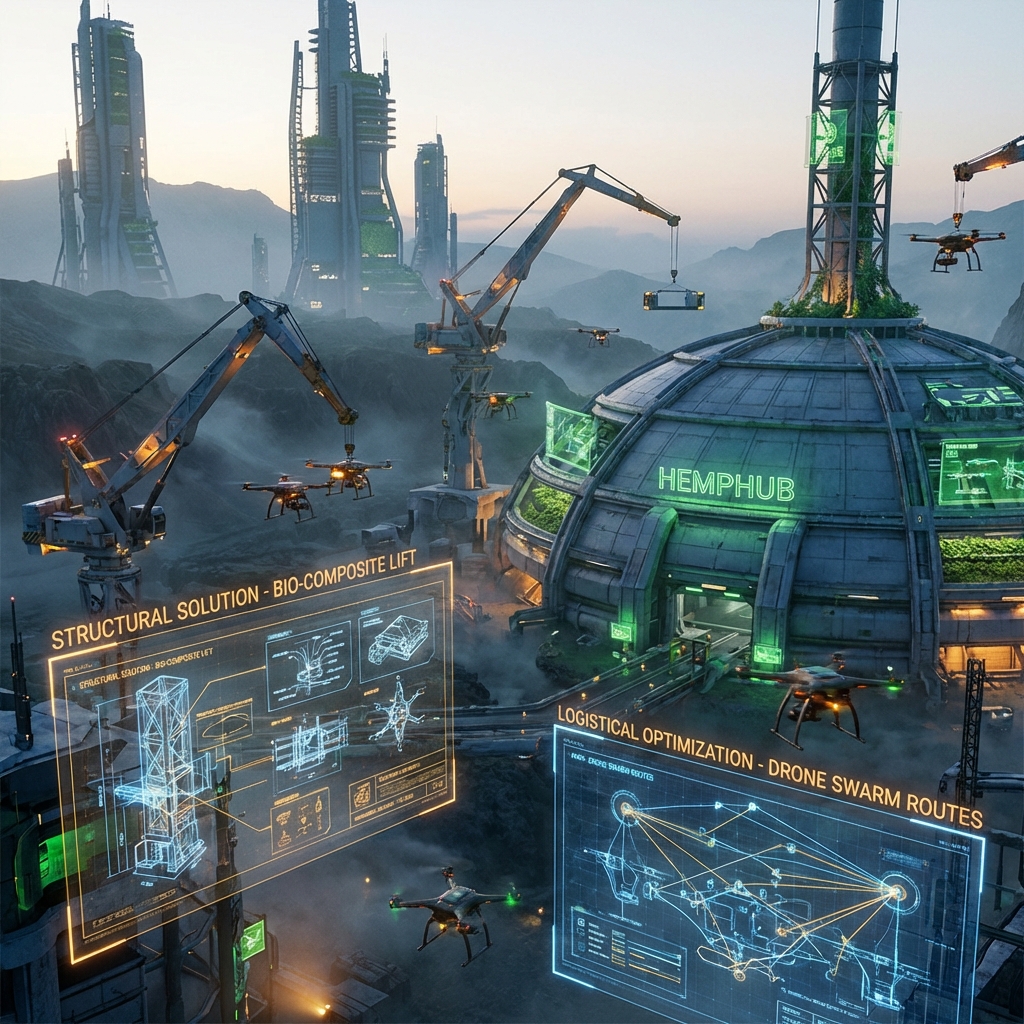
Prompt: A futuristic construction site of a massive Hemphub facility at dawn, symbolizing the overcoming of challenges. In the foreground, complex holographic blueprints float in the air, highlighting solutions to structural and logistical hurdles. In the background, the bio-industrial structure rises triumphantly against a rugged, misty landscape, with construction cranes and automated drones active. Tones of steel blue, amber, and fresh green. High-tech, cinematic, determined atmosphere. 8k resolution.
-
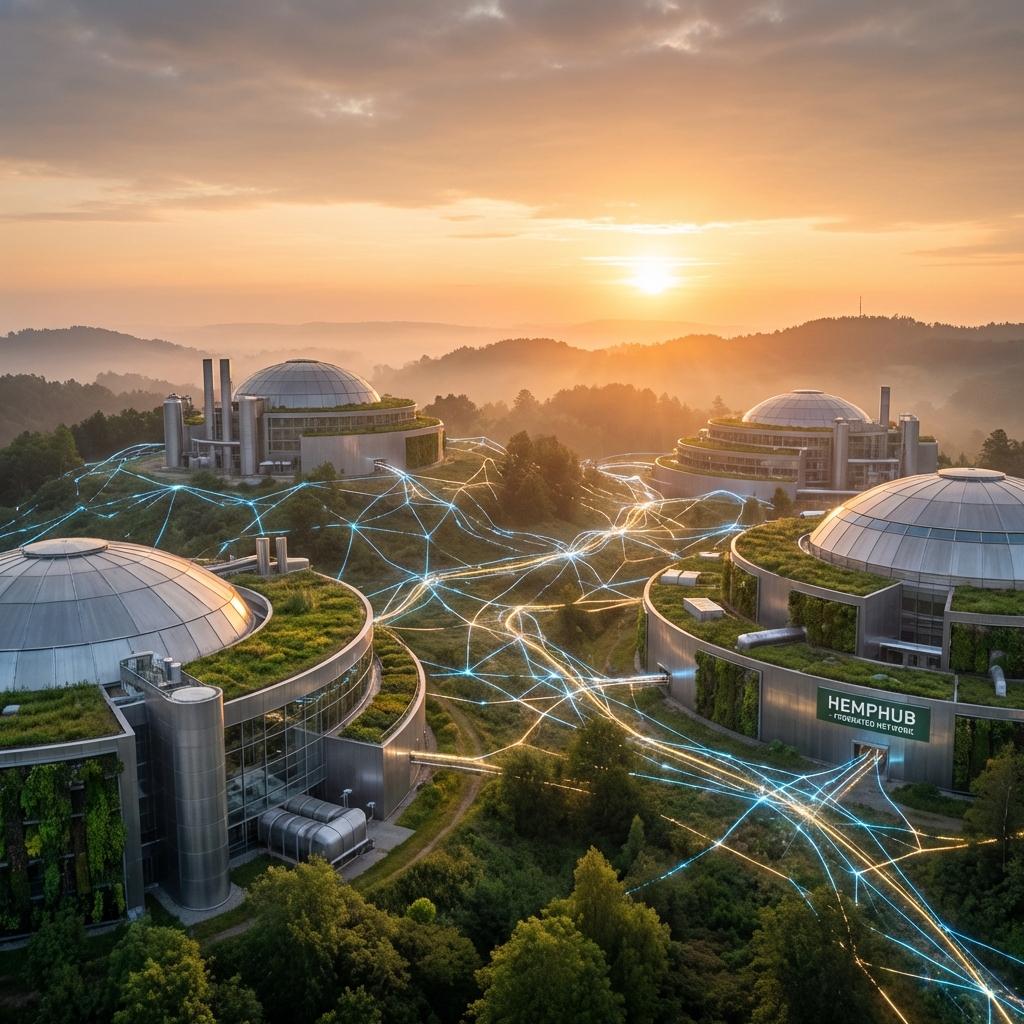
The Federated Hemphub Network – Scaling Synergy Through Connectivity
Yesterday, we outlined the 10-year rollout strategy for a single Hemphub node. But the true promise of the regenerative industrial economy isn’t found in isolated islands of efficiency. It is realized through the creation of a Federated Hemphub Network.
In Phase 3 of our rollout, individual nodes begin to connect, forming a decentralized infrastructure that mimics the resilience of natural ecosystems. When Hemphubs federate, they unlock a series of „Network Effects” that individual facilities simply cannot achieve alone.
The Five Pillars of the Federated Network
1. Shared Knowledge Commons
A network of Hemphubs acts as a unified brain. Whether it’s a breakthrough in fiber refining in Northern Europe or a new carbon-sequestration protocol in North America, innovations are shared across the network. This „Knowledge Commons” ensures that every node operates at the cutting edge of regenerative technology.
2. Collective Market Power
By pooling their outputs and requirements, federated nodes can negotiate on a different scale. This includes bulk purchasing of equipment (reducing CapEx) and unified branding that commands higher prices in global consumer markets. The network prevents the „race-to-bottom” pricing that often plagues fragmented agricultural sectors.
3. Risk Pooling and Resilience
Nature thrives on diversity, and so does the Hemphub network. If one region faces a crop failure or a technical downtime, other nodes in the network can provide backup processing capacity. This geographic diversification turns a collection of vulnerable startups into a robust, anti-fragile industrial backbone.
4. Carbon Credit Aggregation
This is where the Global Hemp Ledger comes to life. By bundling the verified $CO_2$ sequestration from dozens of nodes, the federation can negotiate high-value carbon offset contracts with major corporate buyers. Small farmers gain access to institutional-grade carbon markets that would otherwise be out of reach.
5. Policy and Standards Leadership
A federation speaks with a louder voice. It sets the standards for what truly qualifies as „regenerative” and „traceable,” providing a blueprint for policymakers to follow. This collective advocacy is essential for dismantling the regulatory friction that currently slows the growth of the hemp bioeconomy.
The Physical Architecture of the Regenerative Economy
By federating, Hemphubs move beyond being mere factories. They become the physical nodes of a new global operating system—one that treats the planet’s health as its primary capital.
The transition from „blueprint to network” is the final step in proving that industrial activity can be not just sustainable, but actively restorative.
Source: This network model is derived from the Hemphub Infrastructure Strategy.
Image Generation Prompt:
Prompt: A high-tech, cinematic wide shot of a lush, rolling landscape featuring multiple „Hemphub” industrial structures. The structures are architecturally integrated with green roofs and vertical gardens. Faint, glowing digital lines of connectivity (like a neural network or a fiber-optic grid) pulse between the hubs across the terrain, signifying the „Federated Network.” The lighting is a warm, golden hour sunset, conveying a sense of hope, advanced technology, and ecological harmony. 8k resolution, photorealistic, industrial-organic hybrid aesthetic.
-
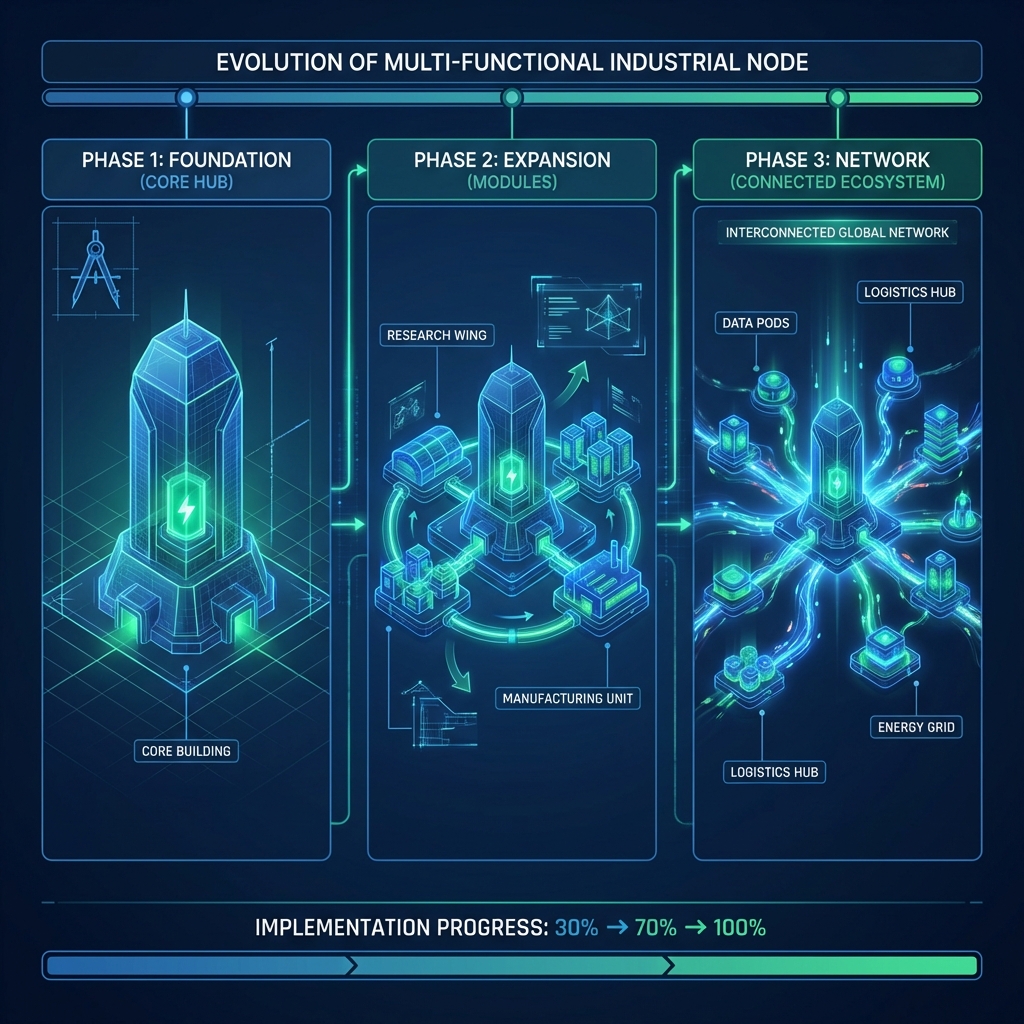
The Hemphub Rollout Strategy – From Blueprint to Network
In the previous two days, we defined the Hemphub and peeked inside its anatomy. Today, we address the most critical question: How do we actually build it?
Building a Regenerative Industrial Node is not a weekend project. It requires a strategic, phased approach that manages risk while scaling impact. Based on the Hemphub Infrastructure Strategy, we can map out a 10-year rollout plan.
The Three Phases of Evolution
Phase 1: Foundation (Years 1-2) – Setting the Core
The first two years are about establishing the physical and legal anchor.
* Site Selection: Identifying rural zones within a 50km radius of viable hemp farmland.
* Primary Processing: Installing the core Decortication Line to handle raw stalks.
* Cultivation Partnerships: Signing long-term contracts with local farmers to guarantee supply.
* Investment: Securing $5-15M in initial CapEx to get the „Core Building” operational.Phase 2: Expansion (Years 3-5) – Adding Complexity
Once the primary processing is stable, the Hemphub grows its „limbs.”
* Secondary Manufacturing: Adding modules for textile fiber refining, hempcrete block production, or oil pressing.
* R&D Commissioning: Opening the on-site laboratory to begin real-time agronomic feedback loops.
* Product Launch: Moving from selling raw materials to selling value-added products (e.g., branded insulation panels).Phase 3: Network Building (Years 6-10) – The Federated Ecosystem
The final phase isn’t about getting bigger; it’s about getting connected.
* Replication: Opening second and third nodes in adjacent regions.
* The Hemphub Federation: Connecting independent nodes via a shared digital platform to pool market power and inventory.
* Carbon Credit Revenue: Achieving full verification of the carbon sequestered across the entire supply chain, creating a significant new revenue stream.Funding the Future: Sustainable Finance
How do we pay for this? The transition requires moving away from pure private equity toward Synergistic Financing:
1. Public-Private Partnerships (PPP): Leveraging government grants for rural development to de-risk the initial infrastructure.
2. Cooperative Models: Allowing farmers to own a stake in the processing facility, ensuring long-term alignment.
3. Carbon Finance: Using the projected carbon sequestration of the hemp crop as collateral for „Green Bonds.”The Goal: A Self-Sustaining Machine
By Year 10, a Hemphub is no longer a startup; it is a Regenerative Industrial Anchor for its region. It provides stable jobs, restores soil health, and produces the materials needed for a net-zero future.
Tomorrow: We’ve built the machine. Now, how does it fit into the wider world? Join us for Day 49: The Global Hemp Ledger.
Source: These implementation phases are detailed in the Hemphub Infrastructure Strategy.
-
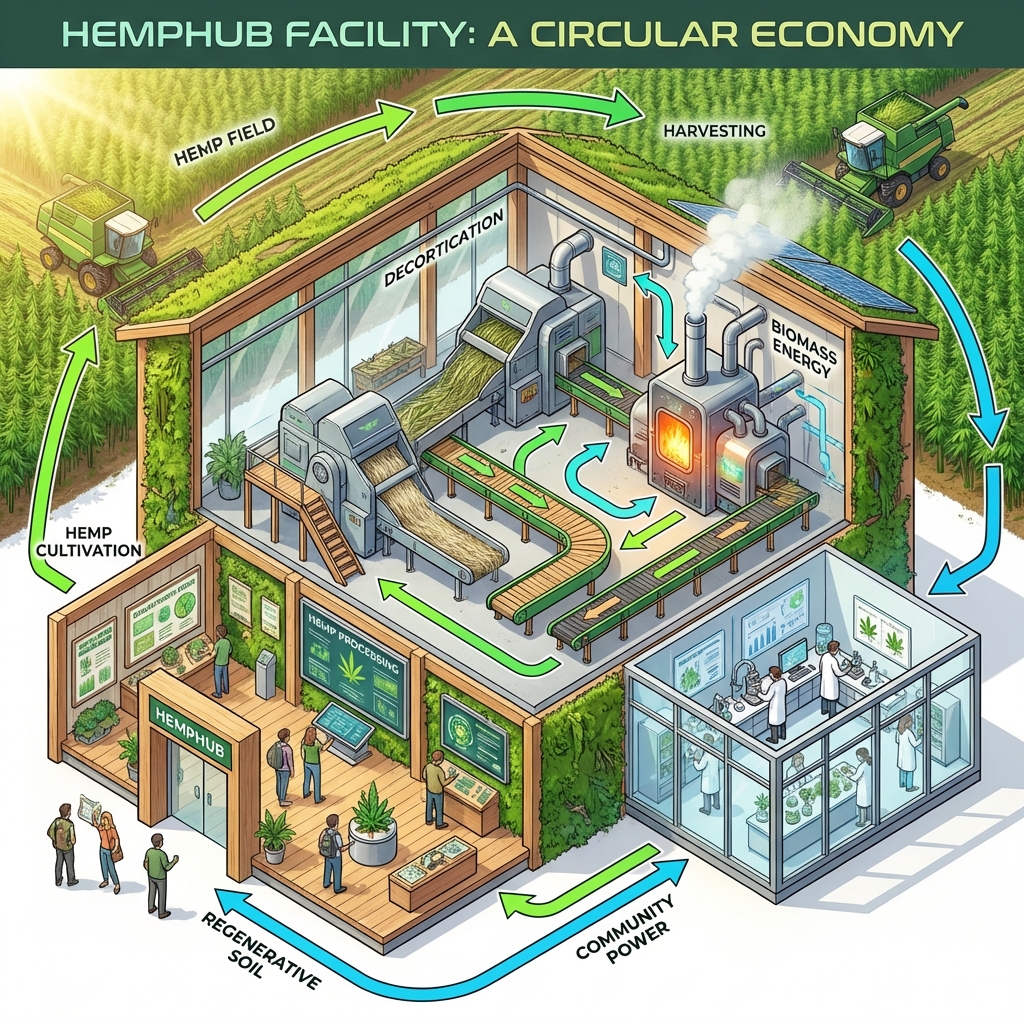
Anatomy of a Hemphub – Inside the Machine
Yesterday, we defined the concept of the Hemphub. Today, we step inside.
To understand why a Regenerative Industrial Node yields a „2+2=5” economic synergy, we need to dissect its anatomy. A Hemphub is not just a building; it is a metabolic system where the output of one organ becomes the fuel for another.
1. The Foyer: Community Interface (The Face)
The first difference you notice upon arrival is that this does not look like a traditional factory. The entrance is a Community Interface.
* Function: Public education, showroom for hemp products, and a meeting place for local farmers.
* Impact: It breaks the „black box” model of industry, integrating the facility into the social fabric of the rural community.2. The Processing Core: Cascading Utilization
Walking onto the main floor, we see the heart of the operation: the Decortication Line.
* Function: This is where the raw biomass is separated into its constituent value streams.
* Level 1 (Fiber): Long technical fibers are extracted for textiles and composites.
* Level 2 (Hurd): The woody core is collected for construction materials (hempcrete) or animal bedding.
* Level 3 (Fines/Dust): Nothing is discarded. The dust is captured.3. The Energy Center: Closing the Loop
In a standard mill, dust is a fire hazard and a disposal cost. Here, it travels via pneumatic tubes to the Bio-Energy Center.
* Function: The dust is burned in a high-efficiency biomass boiler.
* Synergy: The heat generated is piped directly back to the dryers that condition the incoming stalks. The facility powers itself with its own refuse.
* Metric: >85% Energy Self-Sufficiency.4. The R&D Annex: Real-Time Agronomy (The Brain)
Attached to the processing floor is a glass-walled laboratory.
* Function: Scientists analyze incoming batches for fiber strength, cannabinoid content, and moisture levels.
* Impact: This data is not just for Quality Control; it is fed back to the farmers immediately, creating a Real-Time Agronomic Feedback Loop to optimize the next planting season.The Economic Result
By co-locating these functions, the Hemphub achieves what isolated facilities cannot:
* Zero Waste: Every gram of biomass is monetized or utilized.
* Reduced CapEx: Shared infrastructure (loading docks, administrative staff, utilities).
* Resilience: Multiple revenue streams buffer against commodity price fluctuations.Tomorrow: Now that we understand the anatomy, how do we build one? Join us for Day 48: The Hemphub Rollout Strategy.
Source: The principles of cascading utilization and industrial symbiosis are central to the Hemphub Infrastructure Strategy.
-
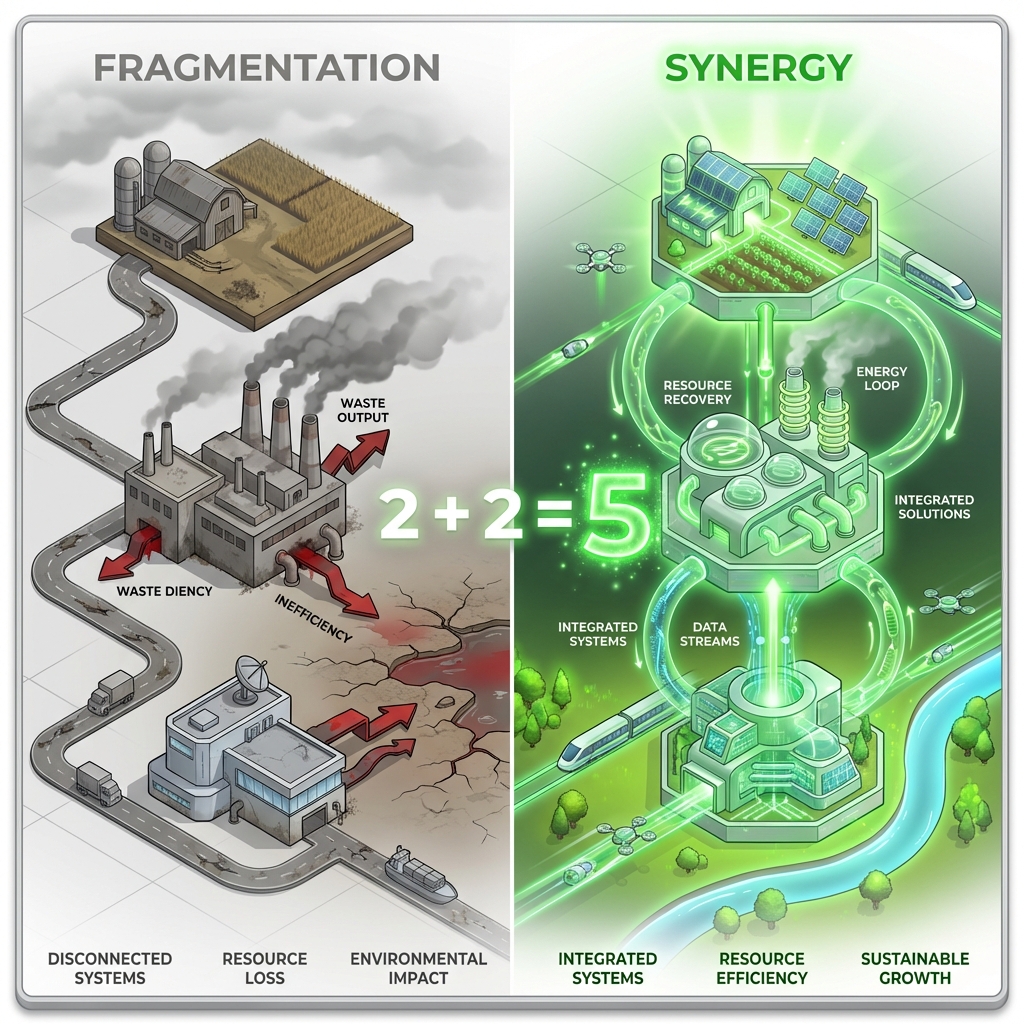
Defining the Hemphub – More Than Just a Factory
Yesterday, we diagnosed the „Infrastructure Crisis” fragmentation and waste. Today, we present the cure.
It is not enough to simply build a hemp processing plant. If we replicate the linear, extractive models of the past, we will get the same results: margin compression and environmental degradation.
We need a new kind of infrastructure. We need the Hemphub.
What is a Hemphub?
A Hemphub is not a factory. It is a Regenerative Industrial Node.
By definition, it is a facility that co-locates and integrates four distinct functions that are usually separated:
1. Cultivation: Direct connection to the surrounding 50km radius of farmland.
2. Processing: Multi-stream manufacturing (fiber, hurd, seed, cannabinoids).
3. R&D: On-site labs for agronomic and product innovation.
4. Community: Education centers and public access points.The 2+2=5 Principle
The core economic thesis of the Hemphub is simple: Synergy.
In a traditional model, a fiber mill, an oil press, and a research lab operating separately generate „1+1+1=3” units of value. They each pay their own overhead, transportation, and waste disposal costs.
In a Hemphub, these functions afford each other Mutualistic Benefits:
* The waste from the fiber line (dust) powers the boiler for the oil press.
* The heat from the oil press dries the incoming stalks.
* The data from the processing line informs the farmers’ next planting cycle immediately.This integration reduces costs and creates new revenue streams from what was previously waste. The result is 2+2=5—the system generates more wealth than the sum of its independent parts.
Cascading Utilization
The mechanism that drives this synergy is Cascading Utilization.
Instead of a single-stream process (e.g., „We only want the fiber”), a Hemphub is designed to capture value at every step of the biomass hierarchy:
1. High Value: Long fiber for textiles.
2. Medium Value: Hurd for hempcrete blocks.
3. Low Value: Dust/Fines for pellets or bio-composites.
4. Chemical Value: Extracted terpenes and waxes.Nothing leaves the node until it has been monetized.
Tomorrow: We will take a walking tour inside the machine. Join us for Day 47: Anatomy of a Hemphub, where we break down the specific functional zones of this facility.
Source: This strategic framework derives from the Hemphub Infrastructure Strategy.
-
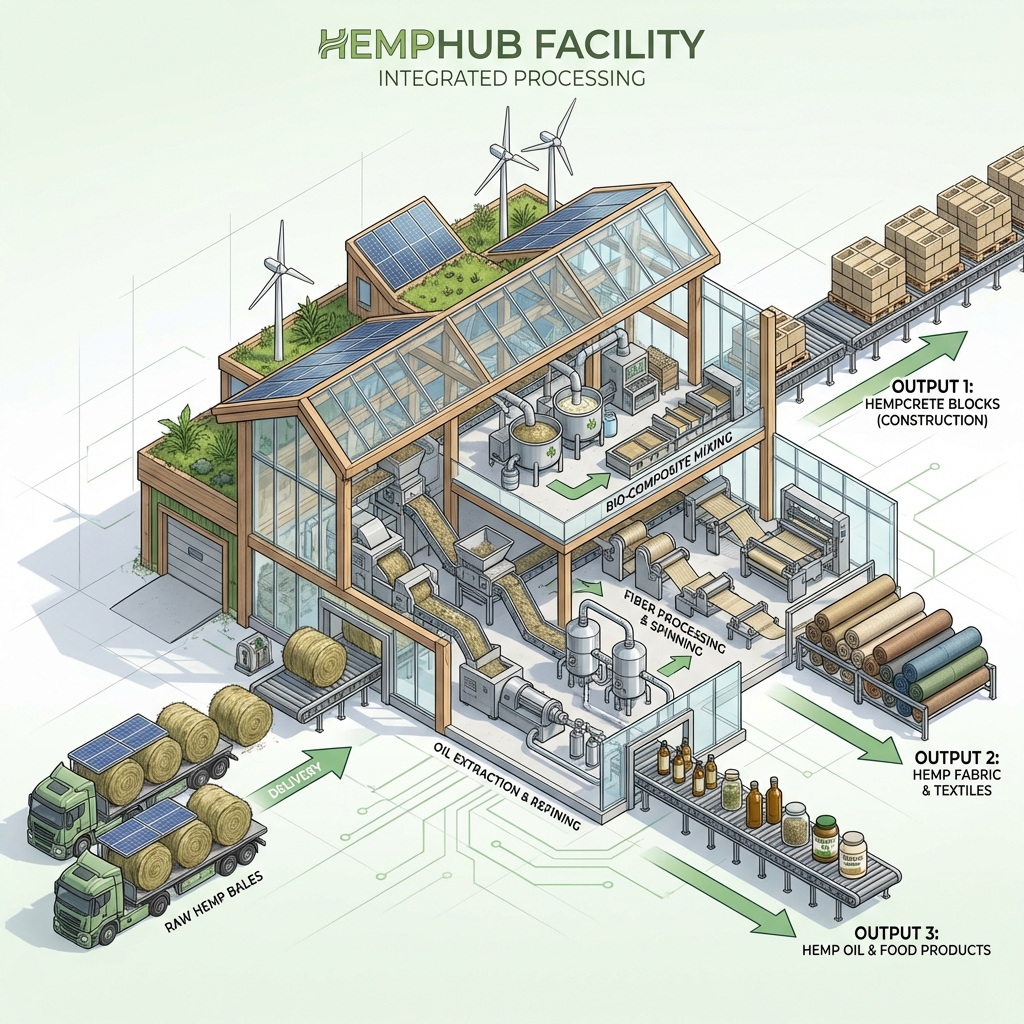
The Synergistic Imperative – Why Our Industrial Infrastructure Needs a Reboot
The promise of the bioeconomy is vast: renewable materials, carbon sequestration, and a shift away from fossil fuels. Yet, despite the buzz around hemp and industrial regeneration, we aren’t seeing the explosive growth predicted. Why?
The problem isn’t the crop. It’s the architecture of our industry.
The Synergistic Gap
We are currently operating in a „Synergistic Gap.” We have the theoretical organizational models (product-market synergy) and the raw biological potential (hemp), but we lack the physical infrastructure to connect them efficiently.
Our current industrial landscape is characterized by three critical failures:
1. Fragmented Processing
Today, a hemp stalk might travel hundreds of kilometers to a decortication plant for fiber, while the seeds are shipped elsewhere for oil pressing, and the „waste” biomass is left to rot or burned. This fragmentation destroys margins. Redundant overhead and transportation costs eat up the profit before the product even hits the shelf.
2. The Single-Stream Trap
Most facilities are designed for a single output—optimizing only for fiber or only for CBD. This approach systematically wastes up to 60% of the plant’s potential value. In a regenerative economy, „waste” is just a resource in the wrong place. By ignoring complementary biomass streams, we are leaving money—and carbon credits—on the table.
3. Knowledge Silos
Research institutions, farmers, and manufacturers often operate in isolation. This prevents the rapid feedback loops necessary for innovation. A farmer might grow a cultivar that processes poorly, but without direct feedback from the factory, they’ll plant it again next year.
The Solution: Enter the Hemphub
To bridge this gap, we need more than just factories; we need Hemphubs.
A Hemphub is defined as a Regenerative Industrial Node: a geographically distributed, vertically integrated facility that co-locates cultivation, multi-stream processing, research, and market access.
By consolidating these functions into a single node, we move from a linear, extractive model to a circular, regenerative one. This isn’t just about efficiency; it’s about unlocking the 2+2=5 effect—where the integrated whole produces exponentially more value than the sum of its isolated parts.
Tomorrow: We will peel back the roof and look inside. Join us as we explore the Anatomy of a Hemphub and the specialized zones that make this machine run.
Source: This strategic framework derives from the Hemphub Infrastructure Strategy.
-

This is a test. If the test works then its great.
# This is a Test. If the Test Works, Then It’s Great! Decoding A/B Testing for Marketing Success
In the dynamic world of marketing, guessing doesn’t cut it. We’re constantly bombarded with data, analytics, and the pressure to optimize every campaign for maximum impact. So, how do we know what truly resonates with our audience? The answer: rigorous testing. This blog delves into the critical role of A/B testing, also known as split testing, explaining why „This is a test. If the test works then it’s great!” should be the mantra of every marketing team.
## What is A/B Testing and Why Should You Care?
A/B testing is a method of comparing two versions of a marketing asset against each other to determine which one performs better. It’s a scientific approach to marketing, replacing gut feelings with concrete evidence. Imagine you’re launching a new email campaign. Instead of relying on instinct, you create two slightly different versions:
* **Version A:** The control version, with the original subject line and call to action.
* **Version B:** The variant, with a tweaked subject line or a different call to action.You then show these two versions to different segments of your audience and measure which one achieves the desired outcome, whether it’s higher open rates, click-through rates, or conversions. The version that performs better becomes the winner, and you implement it for your entire audience.
Why should you care? Because A/B testing allows you to:
* **Maximize ROI:** By identifying the most effective elements of your campaigns, you can generate more leads, sales, and revenue.
* **Reduce Risk:** Avoid costly mistakes by validating your marketing ideas before launching them on a large scale.
* **Improve User Experience:** Gain insights into what your audience prefers, leading to a better overall experience with your brand.
* **Data-Driven Decision Making:** Replace guesswork with data-backed decisions, ensuring your marketing efforts are aligned with what actually works.## Common Elements to A/B Test
The possibilities for A/B testing are virtually endless. Here are just a few common elements you can test:
* **Headlines and Subject Lines:** Test different wordings, lengths, and tones to see what grabs attention.
* **Call-to-Action (CTA) Buttons:** Experiment with different colors, sizes, placements, and wording to encourage clicks.
* **Images and Videos:** Try different visuals to see which ones resonate most with your audience.
* **Website Layouts:** Test different arrangements of content and navigation to improve user flow and conversion rates.
* **Pricing Strategies:** Experiment with different pricing models to find the sweet spot that maximizes revenue.
* **Email Content:** Test different content formats, lengths, and personalization techniques.
* **Landing Pages:** Optimize your landing pages for conversions by testing different headlines, images, and forms.## Best Practices for Effective A/B Testing
While A/B testing is a powerful tool, it’s crucial to follow best practices to ensure accurate and reliable results:
* **Define Clear Goals:** Before you start testing, identify what you want to achieve. What metric are you trying to improve?
* **Test One Variable at a Time:** Change only one element at a time to isolate its impact on the results. If you change too many things at once, you won’t know which change is responsible for the outcome.
* **Use a Large Enough Sample Size:** Ensure you have enough data to draw statistically significant conclusions. Online A/B testing calculators can help determine the required sample size.
* **Run Tests for a Sufficient Duration:** Allow enough time for your tests to collect data under various conditions, such as different days of the week or times of day.
* **Analyze the Results Carefully:** Don’t just look at the overall numbers. Dig deeper to understand why one version performed better than the other.
* **Document Your Findings:** Keep a record of your tests and their results to build a knowledge base and inform future marketing decisions.
* **Iterate and Optimize:** A/B testing is an ongoing process. Use the insights you gain from each test to improve your campaigns further.## Tools for A/B Testing
Numerous tools are available to facilitate A/B testing across various platforms. Some popular options include:
* **Google Optimize:** A free tool for website A/B testing.
* **Optimizely:** A comprehensive A/B testing platform for websites and mobile apps.
* **VWO (Visual Website Optimizer):** A user-friendly A/B testing tool with a visual editor.
* **HubSpot:** A marketing automation platform with built-in A/B testing capabilities.
* **Mailchimp:** An email marketing platform that offers A/B testing for subject lines, content, and send times.## Conclusion: Embracing the Power of Testing
In the competitive landscape of modern marketing, continuous testing is no longer optional; it’s essential. By embracing the mindset of „This is a test. If the test works then it’s great!”, marketers can move beyond intuition and make data-driven decisions that drive real results. A/B testing allows you to fine-tune your campaigns, optimize your user experience, and ultimately, achieve your marketing goals. So, start testing today and unlock the power of data to transform your marketing efforts!