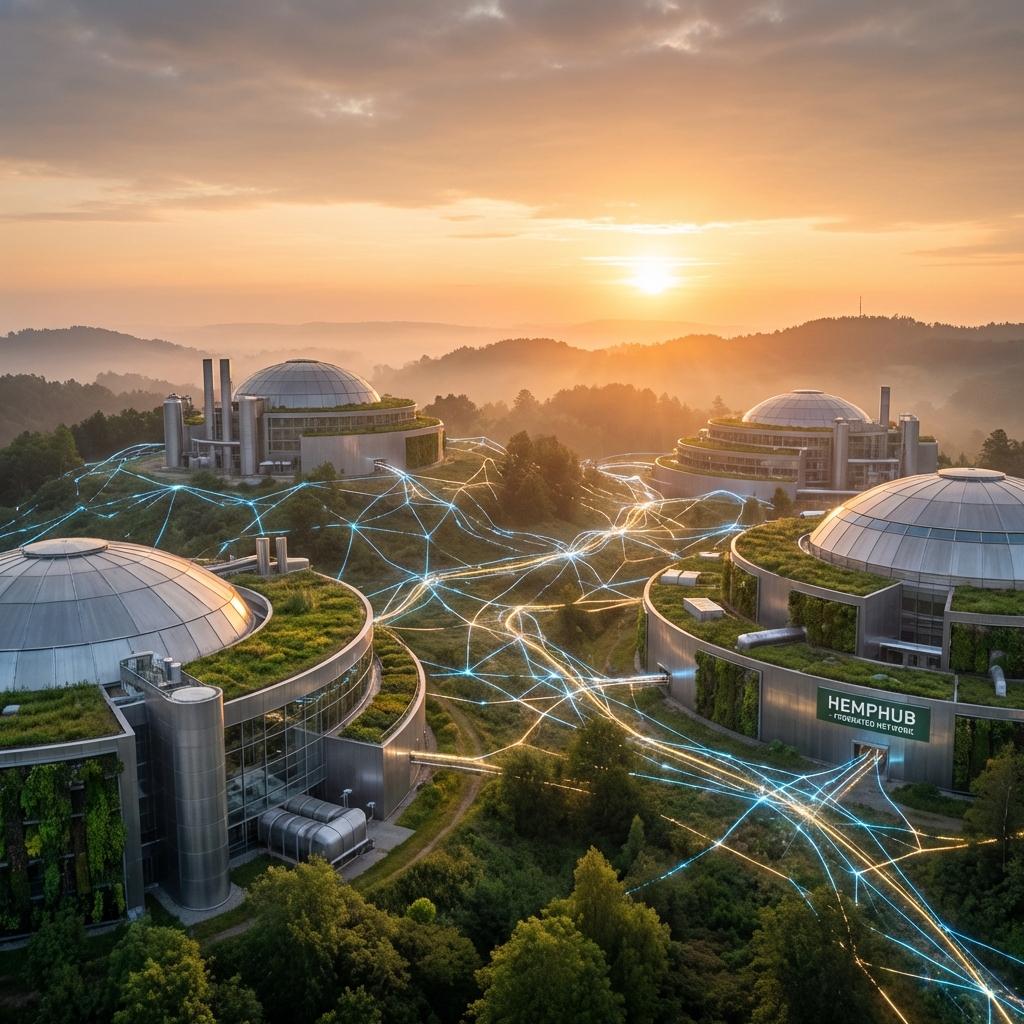
Yesterday, we outlined the 10-year rollout strategy for a single Hemphub node. But the true promise of the regenerative industrial economy isn’t found in isolated islands of efficiency. It is realized through the creation of a Federated Hemphub Network.
In Phase 3 of our rollout, individual nodes begin to connect, forming a decentralized infrastructure that mimics the resilience of natural ecosystems. When Hemphubs federate, they unlock a series of „Network Effects” that individual facilities simply cannot achieve alone.
The Five Pillars of the Federated Network
1. Shared Knowledge Commons
A network of Hemphubs acts as a unified brain. Whether it’s a breakthrough in fiber refining in Northern Europe or a new carbon-sequestration protocol in North America, innovations are shared across the network. This „Knowledge Commons” ensures that every node operates at the cutting edge of regenerative technology.
2. Collective Market Power
By pooling their outputs and requirements, federated nodes can negotiate on a different scale. This includes bulk purchasing of equipment (reducing CapEx) and unified branding that commands higher prices in global consumer markets. The network prevents the „race-to-bottom” pricing that often plagues fragmented agricultural sectors.
3. Risk Pooling and Resilience
Nature thrives on diversity, and so does the Hemphub network. If one region faces a crop failure or a technical downtime, other nodes in the network can provide backup processing capacity. This geographic diversification turns a collection of vulnerable startups into a robust, anti-fragile industrial backbone.
4. Carbon Credit Aggregation
This is where the Global Hemp Ledger comes to life. By bundling the verified $CO_2$ sequestration from dozens of nodes, the federation can negotiate high-value carbon offset contracts with major corporate buyers. Small farmers gain access to institutional-grade carbon markets that would otherwise be out of reach.
5. Policy and Standards Leadership
A federation speaks with a louder voice. It sets the standards for what truly qualifies as „regenerative” and „traceable,” providing a blueprint for policymakers to follow. This collective advocacy is essential for dismantling the regulatory friction that currently slows the growth of the hemp bioeconomy.
The Physical Architecture of the Regenerative Economy
By federating, Hemphubs move beyond being mere factories. They become the physical nodes of a new global operating system—one that treats the planet’s health as its primary capital.
The transition from „blueprint to network” is the final step in proving that industrial activity can be not just sustainable, but actively restorative.
Source: This network model is derived from the Hemphub Infrastructure Strategy.
Image Generation Prompt:
Prompt: A high-tech, cinematic wide shot of a lush, rolling landscape featuring multiple „Hemphub” industrial structures. The structures are architecturally integrated with green roofs and vertical gardens. Faint, glowing digital lines of connectivity (like a neural network or a fiber-optic grid) pulse between the hubs across the terrain, signifying the „Federated Network.” The lighting is a warm, golden hour sunset, conveying a sense of hope, advanced technology, and ecological harmony. 8k resolution, photorealistic, industrial-organic hybrid aesthetic.




Parašykite komentarą