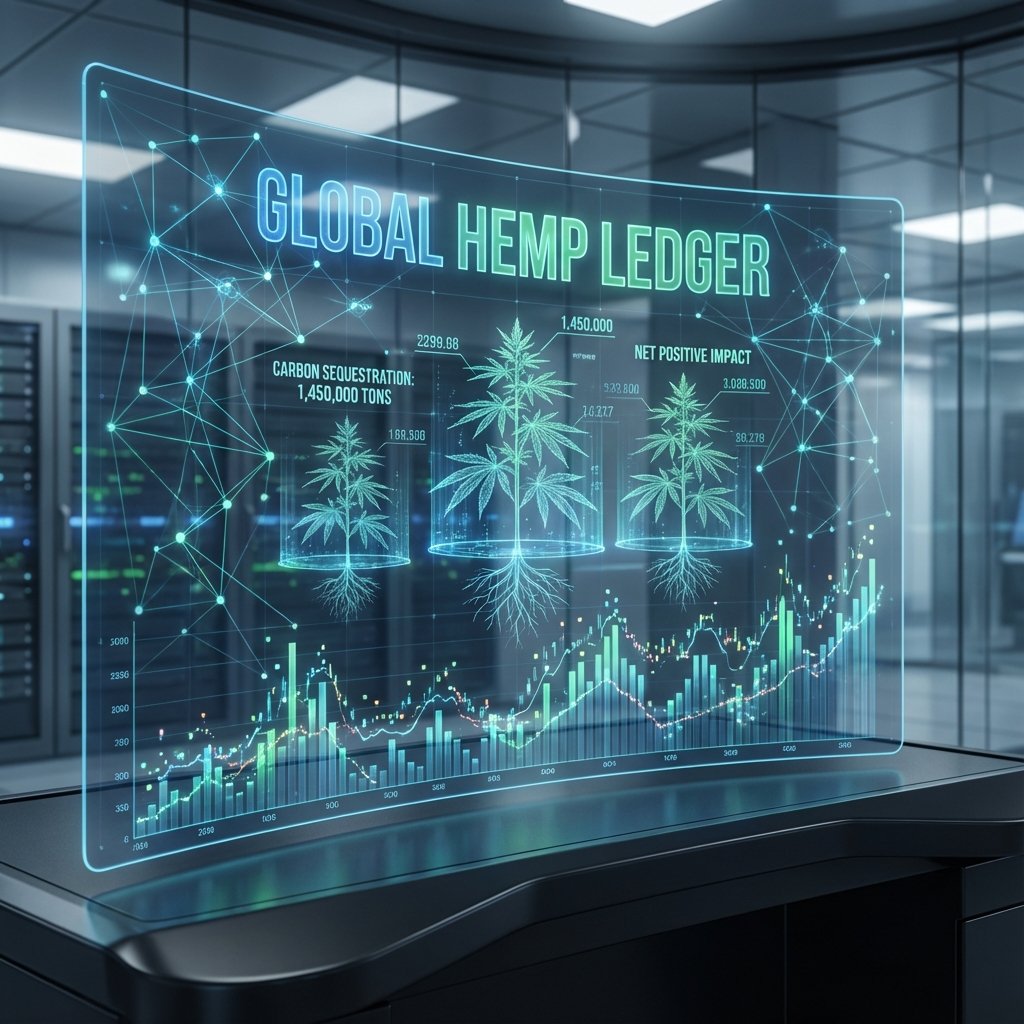
The Tokenization of Biomass and the Transition to a Carbon-Collateralized Economy
Original Source: Planet Hemp Cooperation – Financial Thesis
Abstract: The Liquidity of Sequestration
The traditional financial system faces a structural „valuation gap” regarding regenerative assets. While industrial hemp (Cannabis sativa L.) acts as a premier carbon sink and industrial raw material, its economic value remains locked in fragmented, opaque supply chains. The Global Hemp Ledger (GHL) serves as a decentralized, cryptographic financial protocol designed to bridge this gap. By tokenizing verified carbon sequestration and industrial biomass through a Distributed Ledger Technology (DLT), the GHL creates a high-liquidity, anti-fragile asset class: The Hemp Credit (HC).

The Problem: Market Inefficiency and Information Asymmetry
Current ESG (Environmental, Social, and Governance) and carbon markets suffer from three critical failures:
1. Double-Counting: Lack of immutable tracking allows for the same carbon offset to be sold multiple times.
2. High Transaction Friction: Intermediaries absorb up to 30% of the value in rural-to-industrial financial transfers.
3. Static Valuation: Biomass is valued only upon sale, ignoring the „living value” of the sequestration process during the growth cycle.
The Solution: The GHL Cryptographic Architecture
The Global Hemp Ledger utilizes a Consortium Blockchain to create a transparent, real-time valuation of the entire hemp lifecycle.
Proof of Sequestration (PoS)
Utilizing IoT-linked Eco-Guardian sensors and satellite multi-spectral analysis, the GHL verifies the $CO_2$ drawdown per hectare. This data is etched onto the ledger as a „Minting Event” for a Dynamic NFT (dNFT) representing that specific harvest.
The Triple-Bottom-Line Smart Contract
Every industrial contract is executed via smart contracts that automatically allocate:
* 60% to the Producer (Direct Liquidity).
* 20% to the Resilience Fund (Ecosystem Buffer).
* 20% to the Equity Index 2.0 (Community Dividend).
Financial Engineering: The Resilience Fund as a Macro-Hedge
The GHL introduces the concept of „Biomass-Backing.” Unlike fiat currencies backed by debt, the Planet Hemp internal economy is backed by a physical inventory of high-value industrial materials (hempcrete, bio-resins, fiber).
- Asset-Backed Stability: In periods of fiat inflation, the value of the GHL tokens remains pegged to the industrial utility of the hemp biomass.
- Arbitrage Reduction: By integrating the Supply Chain Finance (SCF) model, the GHL allows small-scale Cultivators to use their „Growth-in-Progress” as collateral for immediate low-interest micro-loans from the Resilience Fund.
The Equity Index 2.0: Measuring Real-Wealth
Traditional GDP fails to account for ecological depletion. The GHL replaces this with the Equity Index 2.0, a multidimensional metric that calculates:
$$Equity = \frac{(Biomass Output \times Market Utility) + Carbon Sequestration}{Resource Depletion Rate}$$
This ensures that „Sovereign” members are rewarded not just for volume, but for the efficiency and calibration of their contribution to the planet’s health.
Conclusion: The Green Renaissance Standard
The Global Hemp Ledger represents a shift from Extract-and-Expend to Sequester-and-Sustain. By providing a professional, audited, and transparent financial framework, it invites institutional-scale investment into the Green Renaissance while protecting the individual sovereignty of the Hemp Nation.
The GHL is not just a ledger of transactions; it is the Financial Blueprint for a planet that treats its biosphere as its most valuable capital.




Parašykite komentarą