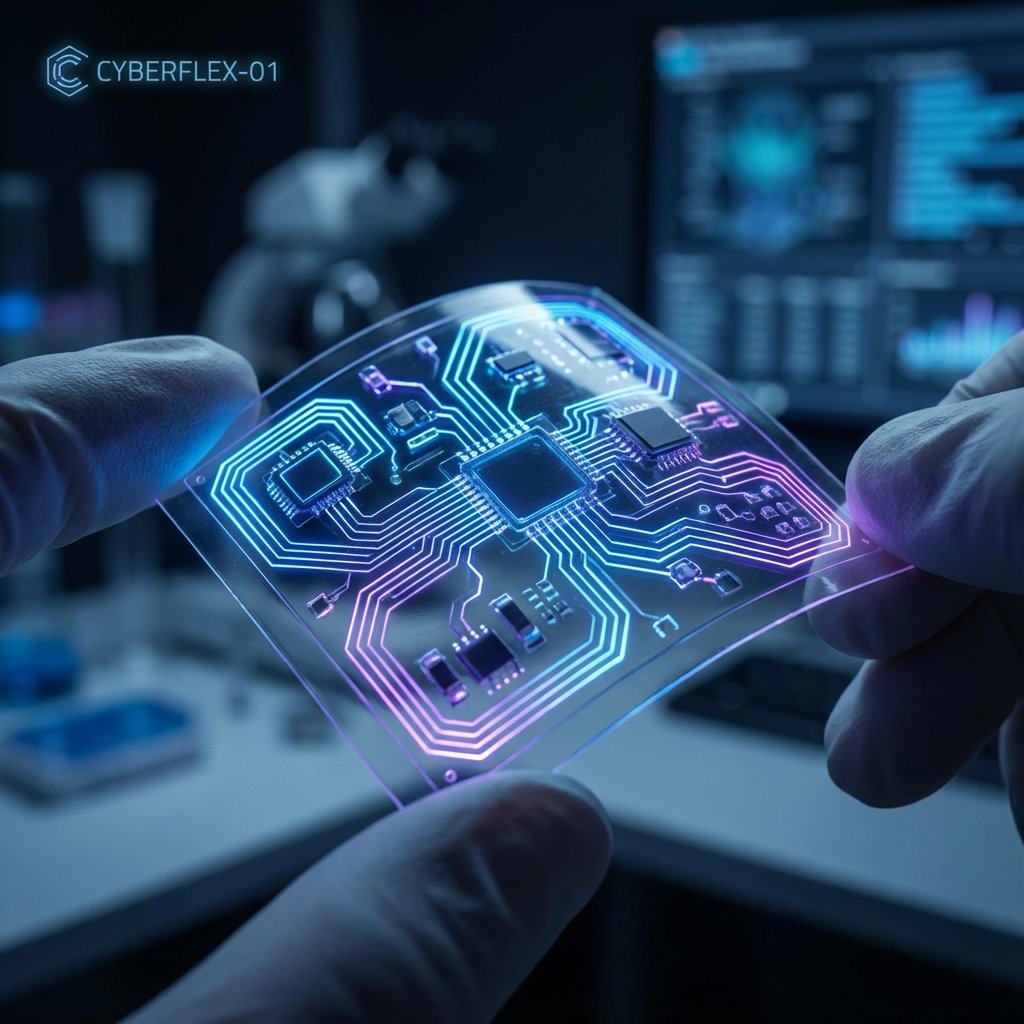
For most of the 20th century, „plastic” was synonymous with „insulator.” We used it to coat wires to prevent shocks, not to carry the current itself. But what if a plastic could conduct electricity just like copper wire? This paradox became reality with the discovery of Conductive Polymers, a breakthrough that earned its discoverers the Nobel Prize in Chemistry in 2000.

Breaking the Rules of Chemistry
Typically, polymers are made of long chains of saturated carbon bonds, which hold their electrons tightly. In conductive polymers (like polyacetylene, polyaniline, or polypyrrole), the carbon backbone is „conjugated”—it has alternating single and double bonds. This structure creates a „highway” for electrons to move along the chain.
When these polymers are „doped” (treated with a small amount of another chemical to add or remove electrons), their conductivity can increase by a factor of a billion, transforming them from insulators to conductors.
Why Do We Need Them?
If we already have copper and gold, why use plastic?
- Flexibility: Conductive polymers can bend, stretch, and roll without breaking. This is the key to flexible electronics.
- Lightweight: They are much lighter than metals, crucial for aerospace and portable devices.
- Processability: They can be dissolved in solvents and printed like ink. Imagine printing a circuit board on your home inkjet printer!
- Transparency: Some conductive polymers are transparent, making them ideal for touchscreens.
Powering the Future
1. Flexible Displays (OLEDs)
The most famous application is the Organic Light Emitting Diode (OLED). Used in high-end smartphones and TVs, OLEDs rely on thin films of organic polymers that light up when electricity passes through them. Because they are plastic-based, they allow for curved screens and potentially foldable phones.
2. Organic Solar Cells (OPVs)
Traditional silicon solar panels are heavy, rigid, and energy-intensive to produce. Organic Photovoltaics (OPVs) use conductive polymers to absorb sunlight and convert it into electricity. While currently less efficient than silicon, they can be printed onto flexible rolls of plastic, allowing for solar-powered tents, backpacks, or even transparent solar windows.
3. Electronic Skin and Wearables
Conductive polymers are soft and biocompatible, making them perfect for interfacing with the human body. Researchers are developing „electronic skin”—sensors that can monitor heart rate, temperature, or even muscle movement, all worn as a comfortable patch or woven into clothing (Smart Textiles).
4. Antistatic Coatings
On a more mundane but vital level, thin layers of conductive polymers are used to coat electronic packaging to prevent static electricity from frying sensitive computer chips during shipping.
The Road Ahead
The next frontier is Molecular Electronics, where single polymer chains act as wires and transistors. We are also seeing the rise of Bio-batteries and Supercapacitors made from conductive polymers that charge in seconds.
By bridging the gap between the biological world (which is soft and organic) and the technological world (which has been hard and metallic), conductive polymers are paving the way for a future where electronics are seamless, invisible, and ubiquitous.




Parašykite komentarą