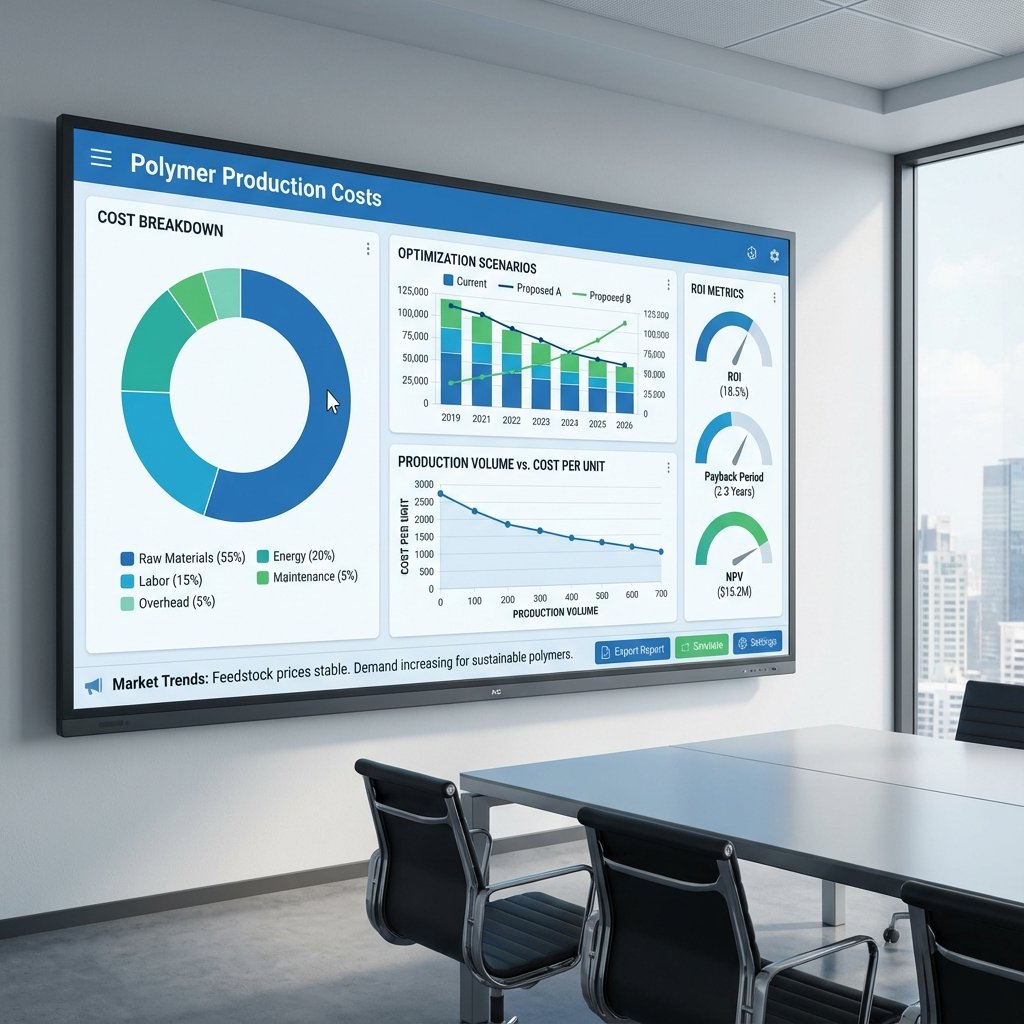
Analysis of cost factors, optimization strategies, and the business case for sustainable polymers.
In the transition to a sustainable bioeconomy, the economic viability of polymer production is just as critical as its environmental impact. For manufacturers and businesses, understanding the cost structure of polymer production—and how to optimize it—is essential for maintaining competitiveness while adopting greener materials.
This article delves into the economics of polymer production, exploring key cost factors, strategies for optimization, and the long-term ROI of investing in sustainable solutions.
The Cost Structure of Polymer Production
The cost of producing polymers is influenced by several interconnected factors, ranging from raw materials to energy consumption and processing efficiency.
1. Raw Material Costs
Raw materials typically account for the largest portion of production costs, often ranging from 40% to 70% of the total expense.
– Traditional Polymers: Prices fluctuate with crude oil markets.
– Biopolymers: Costs are influenced by agricultural feedstock availability (e.g., corn, sugarcane) and processing technologies. While currently often higher than fossil-based alternatives, economies of scale are narrowing this gap.
2. Energy Consumption
Polymer processing—whether extrusion, injection molding, or thermoforming—is energy-intensive. Energy costs can represent 5% to 15% of total production expenses.
– Optimization Opportunity: Switching to energy-efficient machinery and renewable energy sources can significantly reduce operational costs.
3. Capital Equipment and Maintenance
Investment in machinery (CAPEX) and ongoing maintenance (OPEX) are significant drivers. High-quality equipment ensures precision and reduces waste but requires substantial upfront capital.
4. Labor and Overhead
Skilled labor for operating complex machinery, quality control, and general facility overheads also contribute to the final cost per unit.
Strategies for Cost Optimization
To remain competitive, especially when integrating newer, potentially more expensive sustainable materials, manufacturers must focus on efficiency and waste reduction.
1. Material Efficiency and Waste Reduction
- Precision Dosing: Advanced gravimetric feeding systems ensure exact material usage, minimizing giveaway.
- Scrap Recycling: Implementing closed-loop systems to regrind and reuse sprues and runners can recover up to 20% of material costs.
- Design for Manufacturing (DFM): Optimizing part design (e.g., reducing wall thickness without compromising strength) uses less material and cools faster, shortening cycle times.
2. Energy Efficiency Improvements
- Variable Frequency Drives (VFDs): Installing VFDs on motors and pumps adjusts power usage to demand, reducing energy waste.
- Barrel Insulation: Insulating extruder barrels prevents heat loss, lowering the energy required to maintain processing temperatures.
3. Process Automation
Automating repetitive tasks (like part removal and packing) increases speed, consistency, and safety, while reducing labor costs per unit over time.
The Business Case for Sustainable Polymers
While the initial cost per kilogram of biopolymers may be higher, the broader economic picture often favors sustainability when indirect costs and value are considered.
ROI beyond the Price Tag
- Regulatory Compliance: Early adoption of sustainable materials avoids future costs associated with plastic taxes (e.g., the EU Plastic Tax) and stricter waste regulations.
- Brand Value and Premium Pricing: Consumers and B2B clients are increasingly willing to pay a premium for eco-friendly products. Sustainability can be a key differentiator in a crowded market.
- Supply Chain Resilience: diversifying feedstocks away from volatile fossil fuels can provide long-term price stability.
„Cost optimization in polymer production isn’t just about cutting corners; it’s about maximizing value through efficiency, innovation, and strategic material choices.”
Economic Analysis Models
Businesses often use specific models to evaluate production economics:
| Metric | Description | Application in Polymer Production |
|---|---|---|
| Total Cost of Ownership (TCO) | Includes acquisition, operation, and end-of-life costs. | Crucial for comparing durable bioplastics vs. cheaper single-use alternatives. |
| Cycle Time Analysis | The time to produce one part. | Reducing cycle time by seconds can increase output by thousands of units per day, diluting fixed costs. |
| Scrap Rate Analysis | Percentage of defective parts. | Lowering scrap rates directly improves the bottom line and reduces material waste. |
Conclusion
The economics of polymer production are evolving. As technology advances and the bioeconomy matures, the cost disparity between traditional and sustainable polymers will continue to shrink. By focusing on process optimization, energy efficiency, and total value rather than just raw material price, manufacturers can build a profitable and sustainable future.
For Day 30, we will look at the Future of Polymer Innovation, exploring the cutting-edge R&D that will shape the next decade of materials.




Parašykite komentarą