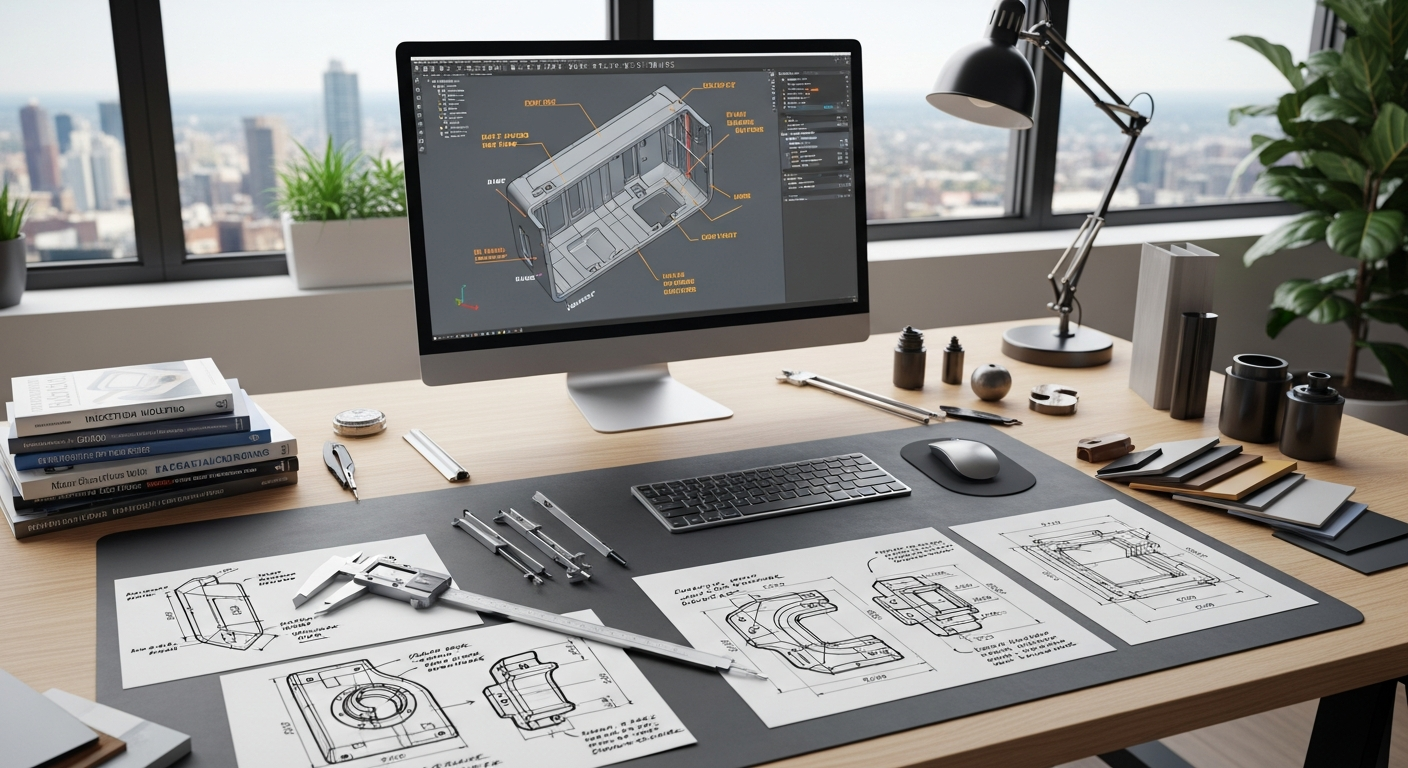
Designing for plastics is fundamentally different from designing for metals or wood. The unique properties of polymers—their shrinkage, flow behavior, and thermal sensitivity—require a specific set of design rules to ensure the final product is both functional and manufacturable.
Whether you are creating a consumer gadget or an industrial component, sticking to these core polymer design principles will help you avoid costly tooling errors, reduce cycle times, and improve product aesthetics.
1. Wall Thickness & Uniformity
The golden rule of plastic design is strict adherence to uniform wall thickness.
- Why it matters: Uneven walls cause uneven cooling. Thicker sections cool slower than thinner ones, leading to internal stresses, warping, and sink marks (depressions on the surface).
- Best Practice: Keep walls constant throughout the part. If you must transition from a thin to a thick section, do so gradually with a ramp or radius, not a sharp step. Typical wall thicknesses range from 2mm to 4mm for general applications.
2. Draft Angles
Draft refers to the taper applied to the faces of the part that are perpendicular to the direction of mold pull.
- Why it matters: Without draft, the part will drag against the mold surface as it is ejected, creating scratch marks (drag marks) or causing the part to stick in the mold.
- Best Practice: Apply a minimum draft angle of 1° to 2° for all vertical walls. Textured surfaces require more draft (often 1° per 0.025mm of texture depth) to release cleanly.
3. Ribs for Stiffness
Instead of increasing the entire wall thickness to make a part stronger (which invites sink marks and long cooling times), use ribs.
- Why it matters: Ribs increase the bending stiffness of a part without adding significant mass or wall thickness.
- Best Practice:
- Rib thickness should be 50-60% of the nominal wall thickness.
- Rib height should generally be no more than 3x the wall thickness.
- Add draft to ribs to ensure ejection.
4. Radii and Fillets
Sharp corners are stress concentrators in plastic parts.
- Why it matters: Flowing plastic dislikes sharp turns; they restrict flow and create weak points where the part is likely to crack under load.
- Best Practice: Add a radius (rounded edge) to all corners.
- Internal Radius: At least 0.5x wall thickness.
- External Radius: Internal radius + wall thickness.
This maintains a constant wall thickness around the corner.
5. Boss Design
Bosses are cylindrical protrusions used for mounting screws or accepting inserts.
- Why it matters: Like ribs, thick bosses can cause sink marks on the opposite show-face.
- Best Practice:
- Connect bosses to the main wall with ribs or gussets for stability.
- Keep the boss wall thickness to about 60% of the nominal wall thickness.
- Leave a gap between the boss and the outer wall if possible to isolate thick sections.
6. Managing Undercuts
Undercuts are features that prevent the part from being ejected directly from the mold (e.g., a side hole or a snap-fit latch).
- Why it matters: Undercuts require complex mold mechanisms like side-actions or lifters, which significantly increase tooling costs.
- Best Practice:
- Design simply to avoid undercuts if possible.
- Use shut-offs (pass-through cores) where a hole in the side of a part is created by the interaction of the two main mold halves, eliminating the need for a side-action.
7. Material Selection in Design
Design cannot exist in a vacuum; it must be paired with the right material.
- Shrinkage: Different polymers shrink at different rates (e.g., Nylon shrinks more than ABS). Your mold dimensions must be scaled to account for this specific material shrinkage.
- Environment: Design for the end-use environment. If the part will be exposed to UV light, design for thicker sections or choose a UV-stable polymer to prevent brittleness over time.
Common Mistakes to Avoid
- Sink Marks: Caused by thick sections (ribs, bosses) pulling the surface inward as they cool. Fix: Generally reduce feature thickness.
- Warping: Caused by non-uniform cooling or internal stresses. Fix: Ensure uniform walls and balanced gate locations.
- Weld Lines: Visible lines where two flow fronts meet. Fix: Adjust gate locations or modify wall thickness to move weld lines to non-critical areas.
Conclusion
Effective polymer design is a balancing act between aesthetics, functionality, and manufacturability. By respecting the physics of molten plastic—focusing on uniform cooling and easy ejection—you can design products that are not only beautiful but also economical to manufacture and reliable in service.
Start with these principles, prototype early (using 3D printing where applicable), and collaborate closely with your mold maker to refine the design for the specific production process.




Parašykite komentarą