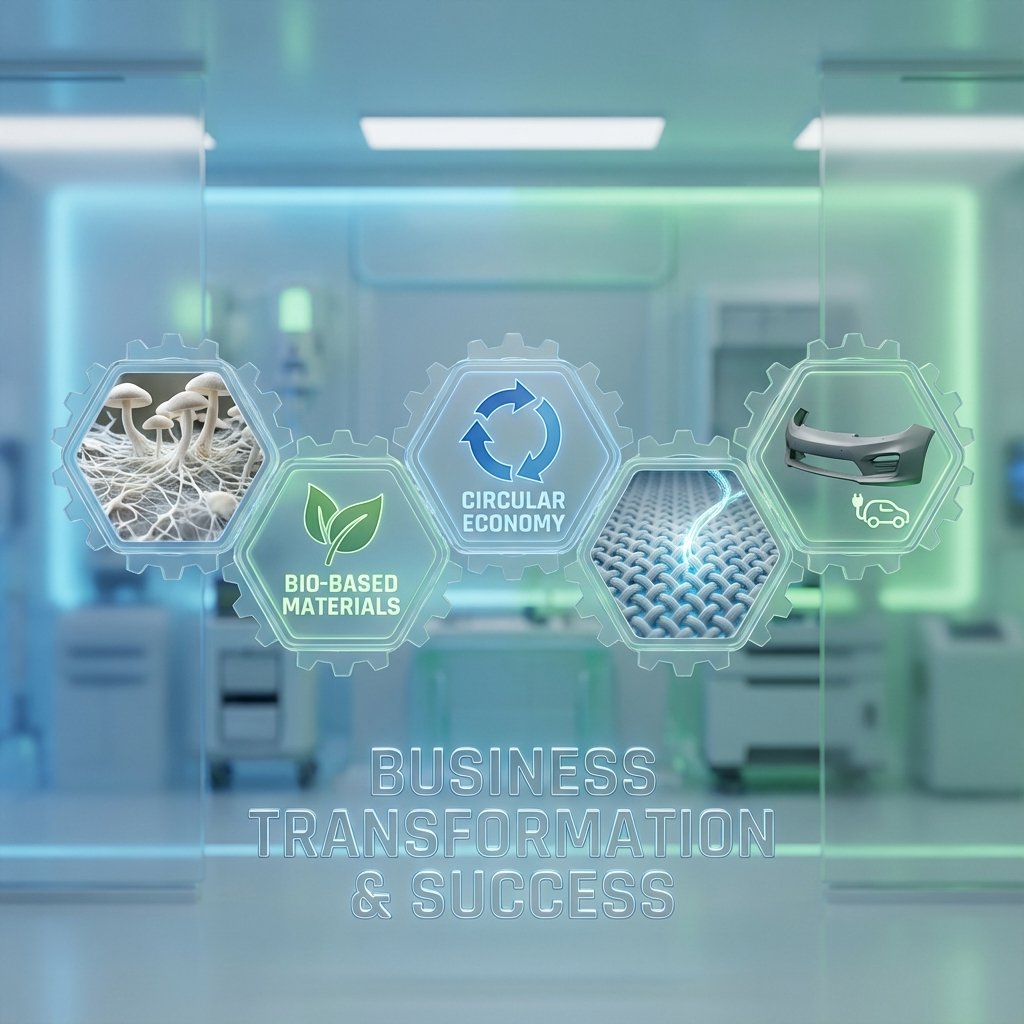
In the rapidly evolving world of material science, companies are increasingly turning to advanced polymer solutions to drive sustainability, efficiency, and innovation. From bio-based materials to revolutionary recycling technologies, these success stories demonstrate the transformative power of modern polymers.
Here are 5 companies that are setting new standards with their innovative use of polymer solutions.
1. Ecovative Design: Growing Packaging from Mushrooms
The Challenge: Traditional Styrofoam packaging is excellent for protection but terrible for the environment, taking centuries to decompose and often ending up in landfills or oceans.
The Solution: Ecovative Design developed a technology to grow packaging using mycelium (the root structure of mushrooms) and agricultural byproducts like hemp hurds. This creates a fully biodegradable and compostable alternative to expanded polystyrene (EPS).
The Result:
* Sustainability: Their MycoComposite™ material requires less energy to produce than plastic foam and breaks down in home compost in just 45 days.
* Performance: It offers comparable protection and durability to synthetic foams.
* Adoption: Major brands like Dell and IKEA have explored or adopted mushroom packaging, significantly reducing their packaging footprint.
2. NatureWorks: Mainstreaming Bio-Based Plastics
The Challenge: Reducing reliance on fossil-fuel-based plastics without sacrificing performance in everyday applications like food service ware and hygiene products.
The Solution: NatureWorks pioneered the commercial production of Ingeo™, a polylactic acid (PLA) biopolymer derived from renewable plant sugars (corn, cassava, sugar cane).
The Result:
* Carbon Footprint: Ingeo produces approximately 80% less greenhouse gases than traditional synthetic polymers like polystyrene.
* Versatility: It is now used globally in coffee capsules, yogurt cups, tea bags, and even 3D printing filaments, proving that bio-based plastics can meet rigorous industrial standards.
3. PureCycle Technologies: Revolutionizing Polypropylene Recycling
The Challenge: Polypropylene (PP) is one of the most widely used plastics but also one of the least recycled due to difficulty in removing contaminants, odors, and colors.
The Solution: PureCycle employs a ground-breaking solvent-based purification process licensed from Procter & Gamble. This technology separates color, odor, and contaminants from plastic waste feedstock to transform it into ultra-pure recycled (UPR) resin.
The Result:
* Circularity: The UPR resin has near-virgin properties, allowing it to be reused in high-quality applications multiple times, effectively closing the loop on PP waste.
* Impact: This technology unlocks the potential to recycle billions of pounds of PP waste that would otherwise be landfilled.
4. BASF: Closing the Loop on Textiles with loopamid®
The Challenge: Textile-to-textile recycling has been notoriously difficult, especially for blended fabrics and complex materials like nylon 6, leading to massive textile waste.
The Solution: BASF developed loopamid®, a solution for the chemical recycling of polyamide 6 (nylon 6). This process breaks down used textiles into their chemical building blocks, which are then used to synthesize new virgin-quality polymer fibers.
The Result:
* Innovation: It allows for the recycling of colored and mixed textile waste that mechanical recycling cannot handle.
* Collaboration: Brands like Inditex (Zara) have already launched collections using loopamid®, demonstrating the commercial viability of circular fashion.
5. Ultra-Poly Corporation: Turning Car Bumpers into New Products
The Challenge: Automotive bumper covers (fascias) are large, bulky, and difficult to recycle, typically ending up as industrial waste.
The Solution: Ultra-Poly Corporation developed a proprietary reverse logistics and processing system to collect used bumper covers from autobody shops. They grind and reprocess this material into a consistent, high-quality recycled polyolefin (TPO).
The Result:
* Resource Recovery: They divert millions of pounds of plastic from landfills annually.
* New Life: The recycled material is used to manufacture new automotive parts, construction materials, and other industrial products, creating a robust secondary market for what was once considered „trash.”
The Takeaway
These success stories highlight a common theme: innovation is driving sustainability. Whether it’s growing materials from nature, purifying waste into virgin-quality resin, or closing the loop on complex products, these companies prove that economic success and environmental stewardship can go hand in hand.
As technology advances, we can expect even more ground-breaking applications of polymer science that will redefine how we produce, use, and reuse materials in the future.




Parašykite komentarą